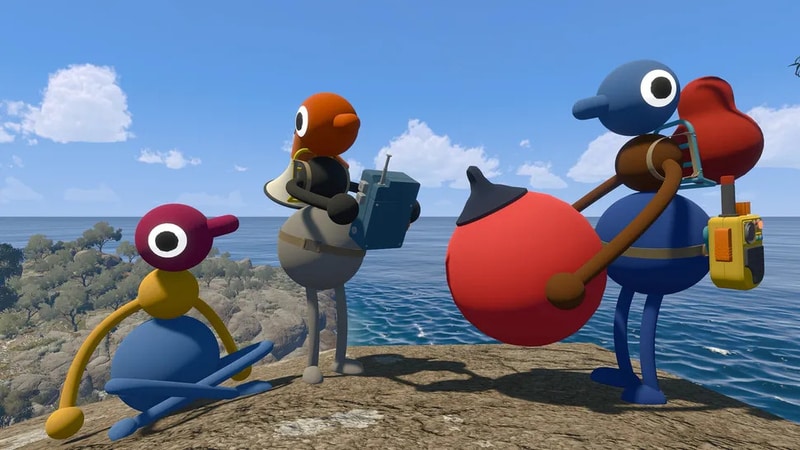
Big Walk is a cooperative online "walker-talker" videogame from House House, launched as a social puzzle experience featuring proximity chat and physics-based interaction. Players control blobby, ant-like avatars with independent arm controls, designed to pick up objects, lift teammates and solve environmental challenges together.
Gameplay centers on brief, interlocking puzzles scattered across a colorful open world with a day-night cycle, with unique mechanics like team stacking to reach high switches and area-wide progression gates that unlock after local puzzles have been completed. The title supports up to 12 players in a session, though individual puzzles scale to groups of up to four and spaces for non-puzzle socializing are included.
For players, Big Walk reframes co-op play as collaborative problem solving and low-stakes socializing: its proximity-only voice, shared-object mechanics and celebratory feedback reinforce teamwork and conversation. As a trend, it exemplifies social-first game design that blends gentle puzzles with emergent player interactions.
Image Credit: Panic
What Makes This Trend Stand Out
- Social-first Game Design
- A movement prioritizing conversation and low-stakes collaboration that can redefine player retention through community-driven progression and emergent social rituals.
- Physics-based Cooperative Mechanics
- Physics-driven interactions between independent avatars create unpredictable problem-solving moments that enable novel toy-like systems and shared-object economies.
- Proximity-voice Socializing
- Proximity-limited voice creates ambient, local conversations that foster serendipitous social encounters and micro-communities within larger sessions.
Sectors Adopting This
- Multiplayer Game Development
- Design paradigms focused on small-group puzzles and shared-object physics that open pathways for modular, scalable co-op experiences and new matchmaking models.
- Team-building and Corporate Training
- Low-pressure cooperative puzzles and proximity communication which can reframe remote collaboration exercises around playful problem solving and interpersonal rapport.
- Live Social Platforms
- Persistent social spaces with spatialized voice and emergent interactions that support monetizable events, user-generated content, and community governance experiments.