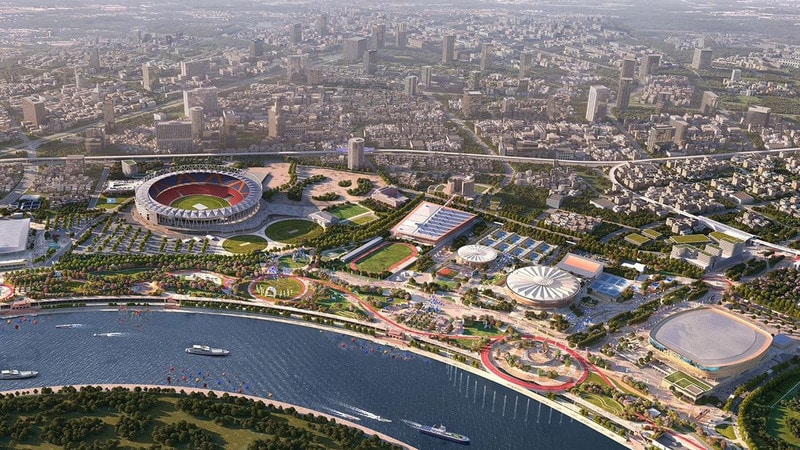
The Sardar Vallabhbhai Patel Sports Enclave refers to a proposed 350-acre precinct in Amdavad, India, designed by an international consortium including BDP, Cox Architecture and Collage Design as a comprehensive sports and civic district masterplan. The plan situates the enclave along the Sabarmati River beside the 132,000-seat Narendra Modi Stadium and organizes major sporting venues, public spaces and landscaped boulevards into a unified urban framework. Facilities within the precinct include an international-standard Tennis Centre with multiple courts, an 18,000-seat indoor arena, an Aquatic Centre with scalable capacity and a National Institute of Sports Excellence, addressing both elite competition and community use.
The masterplan integrates plazas, gardens, pedestrian boulevards and civic spaces such as a central games plaza along the riverfront, designed to host gatherings and social activities year-round. Climate responsiveness and environmental considerations, such as passive ventilation and shade strategies, are embedded in the spatial layout to enhance comfort in the region’s warm climate. The
Image Credit: BDP
What Makes This Trend Stand Out
- Integrated Sports-civic Districts
- Large-scale precincts that merge elite competition venues with public plazas and community facilities create potential for continuous footfall and diversified revenue streams across sports, leisure and civic programming.
- Climate-responsive Stadium Design
- Passive ventilation, shading and landscape-driven microclimates in warm-region masterplans point to opportunities for reducing operational energy use and improving spectator comfort without heavy mechanical systems.
- Scalable Multi-use Venues
- Modular arenas and aquatic centers with variable capacities suggest new possibilities for cost-efficient facility utilization that can accommodate elite events, community programming and temporary configurations.
Sectors Adopting This
- Urban-planning and Real-estate Development
- Comprehensive sports enclaves adjacent to major stadiums indicate untapped value in placemaking-led real estate that blends commercial, residential and public realms around event-driven demand.
- Sports-technology and Facilities-management
- Integration of adaptive venue infrastructure and spectator comfort systems reveals scope for technology-driven lifecycle management, remote operations and data-informed maintenance models.
- Hospitality and Event-services
- Year-round civic programming and large-capacity event spaces highlight opportunities for novel hospitality formats and scalable service models that cater to both large-scale events and everyday community use.