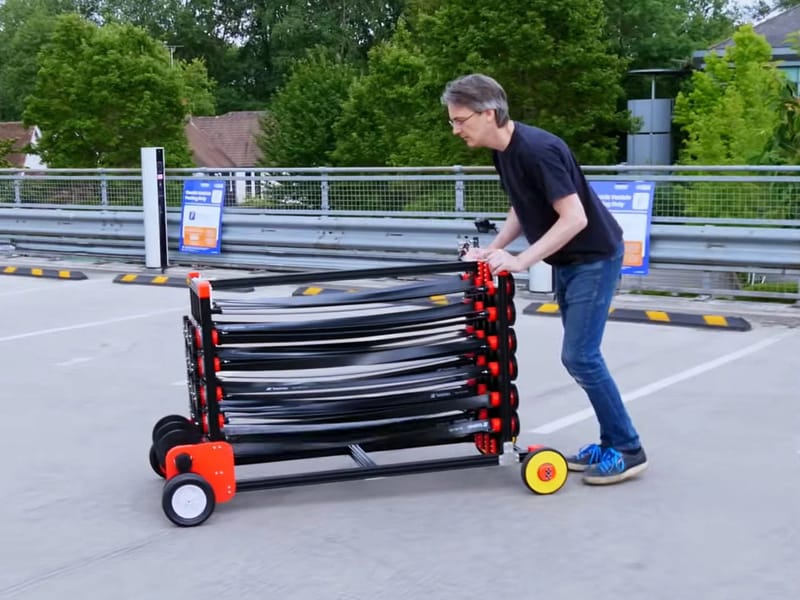
The resistance band vehicle was developed by James Bruton as an experimental prototype that converts energy stored in twisted fitness resistance bands into vehicle propulsion. Built from 4040 aluminum extrusions, CNC-machined brackets, 3D-printed components, and thrust bearings, the drivetrain uses bevel gears to transfer torque from the elastic bands to the wheels.
Early prototypes employed a single band before progressing through multiple gear reductions to improve power delivery and reduce stress on the elastic mechanism. The design demonstrates how gearing influences the conversion of stored mechanical energy into controlled motion.
The prototype evolved from a single-band system to a drivetrain using eighteen resistance bands arranged in three parallel groups connected to a common output shaft. Testing showed that increasing the number of bands alone did not proportionally increase usable torque, leading to a redesigned transmission that balanced power and unwinding time more effectively.
Image Credit: James Bruton
What's Driving This Trend
- Elastic Energy Propulsion
- Mechanical storage systems using twisted bands or springs present low-cost alternatives for short-range mobility where batteries are impractical, expensive, or overly complex.
- Modular Prototype Drivetrains
- Experimentation with aluminum extrusion frames, 3D-printed parts, and CNC brackets highlights faster iteration paths for unconventional vehicle powertrains and educational transport platforms.
- Low-tech Mobility Systems
- Non-electrical propulsion concepts reveal niche potential in off-grid transport, recreational devices, and demonstrations of energy conversion without reliance on charging infrastructure.
Who This Affects Most
- Micro-mobility
- Compact vehicles powered by alternative mechanical energy could expand design possibilities for lightweight scooters, carts, and novelty transport systems in constrained environments.
- Engineering Education
- Hands-on prototypes that visualize torque, gearing, and stored energy offer practical tools for teaching mechanical design, physics, and iterative problem-solving.
- Sustainable Transportation
- Battery-free propulsion experiments suggest emerging opportunities for ultra-simple mobility formats that reduce material intensity and broaden access to low-emission transport concepts.