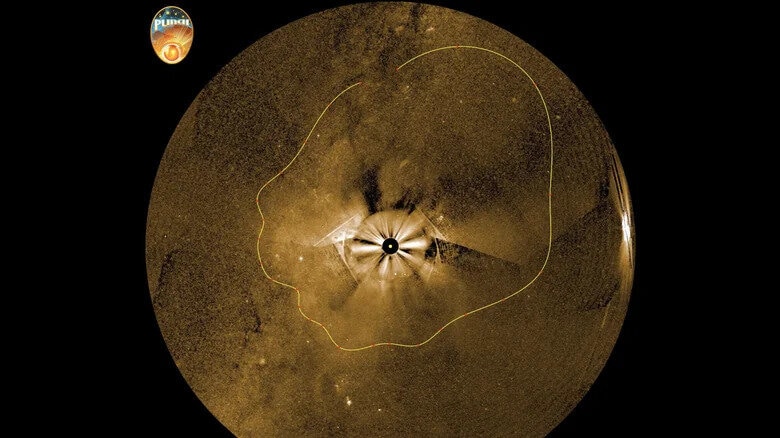
PUNCH mission uses a constellation of four microsatellites to continuously monitor the Sun and track coronal mass ejections from eruption through their journey toward Earth. During analysis of a coronal mass ejection observed on May 31, 2025, researchers processed the first 12 hours of imagery to model the event's speed and shape before predicting its arrival at Earth. The forecast was accurate within approximately 30 minutes, a substantial improvement over existing methods that typically have an error margin of around five hours.
The mission captures solar imagery every four minutes, allowing scientists to observe nearly the entire path of a coronal mass ejection rather than only a small portion of its trajectory. Continuous observations provide more complete datasets for computer models that estimate the timing of geomagnetic storms capable of disrupting satellites, communications systems, radio networks, and electrical infrastructure. The findings have been submitted as an initial proof of concept for review in the Space Weather journal.
Image Credit: NASA
What Makes This Trend Stand Out
- Continuous Solar Monitoring
- Persistent microsatellite imagery creates room for predictive space-weather services that reduce uncertainty for infrastructure operators and satellite networks.
- Precision Storm Forecasting
- More accurate coronal mass ejection arrival models could reshape risk management tools for utilities, telecom providers, and aerospace firms.
- Microsatellite Constellations
- Compact satellite networks offer scalable data-collection architectures that can outperform legacy observation systems in specialized scientific missions.
Sectors Adopting This
- Space Technology
- Advanced solar-observation platforms expand commercial possibilities for satellite manufacturers, analytics providers, and orbital monitoring firms.
- Energy Infrastructure
- Grid operators gain value from improved geomagnetic storm intelligence that supports more resilient planning for electrical transmission systems.
- Telecommunications
- Radio, satellite, and communications networks may benefit from earlier disruption forecasts that improve reliability across critical connectivity services.