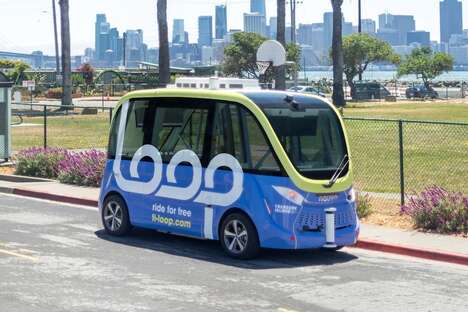
While Google continues to test its autonomous cars, Singapore's Nanyang Technological University will soon debut the Navia Autonomous Shuttle. The Navia will ferry passengers from the school to the nearby JTC Corporation's CleanTech Park. The shuttle was built by Induct Technology of France and can seat up to eight people. The Navia Autonomous Shuttle features four LIDAR (Light Detection and Ranging) units and stereoscopic optical cameras to guide itself from place to place.
All riders need to do is board the shuttle, select a destination via a touchscreen and enjoy the ride. Once the trip is complete the shuttle automatically goes back to its fast-charging station. The Navia won't go faster than 12 mph, so high-speed crashes won't be a worry. The idea behind the Navia Autonomous Shuttle is that one day it could be used to help alleviate the "the first mile and last mile" traffic issues that many urban transit systems deal with.
Why This Trend Is Growing
- Autonomous Shuttles
- The development of autonomous shuttles like the Navia presents an opportunity for disruptive innovation in public transportation systems.
- Driverless Vehicles
- Advancements in driverless vehicle technology, showcased by the Navia Autonomous Shuttle, indicate potential disruptive innovations in the automotive industry.
- Smart Mobility
- The emergence of smart mobility solutions, such as the Navia Autonomous Shuttle, opens up possibilities for disruptive innovation in urban transportation systems.
Industries Being Reshaped
- Public Transportation
- The autonomous shuttle trend has the potential to disrupt the public transportation industry by offering more efficient and convenient transit options.
- Automotive
- The development of driverless vehicles, exemplified by the Navia Autonomous Shuttle, introduces disruptive innovation opportunities in the automotive industry.
- Smart Cities
- The automation of transportation, as seen in the Navia Autonomous Shuttle, presents disruptive innovation opportunities in the development of smart city infrastructure.