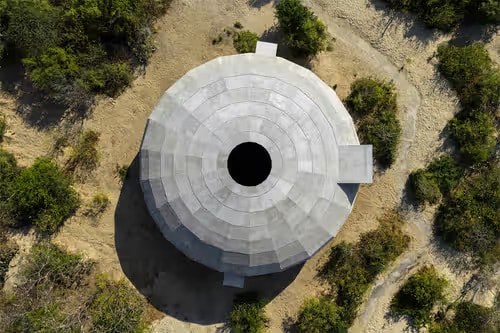
The Casa Wabi Mushroom Pavilion is a structure in Puerto Escondido designed by OMA, led by Shohei Shigematsu, for Fundación Casa Wabi. The building is formed as a low, domed volume constructed from cast-in-place concrete, with a continuous shell that defines both the exterior and interior surfaces. The layout is organized around a central space, with surrounding zones designated for mushroom cultivation, preparation, and storage.
The interior includes stepped platforms that function as seating and as surfaces for placing terracotta vessels used in the growing process. Openings at the top and along the base of the structure allow light and air to circulate through the space, supporting the environmental conditions required for cultivation. The concrete surface is textured using burlap formwork, creating a rough finish that interacts with moisture and light over time.
Image Credit: Rafael Gamo
Key Themes Behind This Trend
- Adaptive Agricultural Architecture
- Buildings that integrate cultivation zones with communal and ceremonial spaces indicate new models for combining food production with social programming.
- Multi-functional Cultivation Hubs
- The fusion of processing, storage and gathering areas within a single pavilion points to compact facilities that support both production workflows and experiential uses.
- Textured Material Patination
- A focus on formwork-driven surface texture where concrete interacts with moisture and light suggests materials designed to age visibly and communicate environmental performance over time.
Where This Applies
- Architecture and Design
- Design practices are exploring hybrid typologies that merge agricultural systems with public architecture, implying opportunities for firms to reconceive programmatic boundaries.
- Urban Agriculture
- Small-scale, integrated cultivation sites within civic or cultural projects reveal possibilities for expanding productive landscapes into dense built environments.
- Sustainable Construction
- Use of cast-in-place concrete with tactile formwork emphasizes material strategies that balance durability, microclimate control and embodied sustainability concerns.