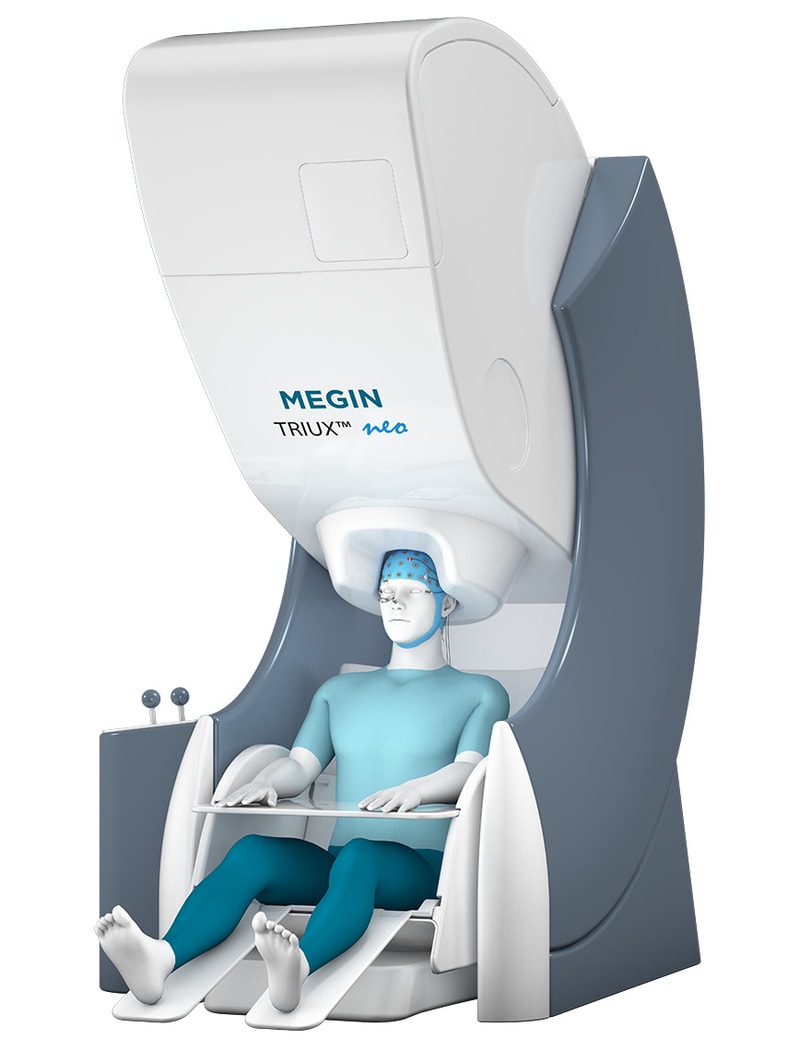
MEGIN has established a side-by-side dual-MEG hyperscanning facility at Tsinghua University in Beijing. The innovation features two TRIUX neo whole-head magnetoencephalography systems housed in adjacent magnetically shielded rooms and linked through a custom integration layer developed by Aalto University. The device enables simultaneous, millisecond-synchronized brain recording from two interacting participants during natural conversation, cooperation, and play.
MEGIN's configuration overcomes the limitations of previous MEG-based hyperscanning approaches, which typically required two laboratories in different locations connected by long-distance links that introduced latency and constrained the types of social interaction that could be studied, whereas the Tsinghua facility allows participants to see and hear each other through a direct audio-visual connection without internet intermediation. Each of the two rooms houses a full whole-head TRIUX neo system capable of adult and pediatric recordings, and the open-source software developed by Dr. Andrey Zhdanov ensures unified, real-time experimental control across both systems, with microsecond-level clock synchronization and sufficiently low audio-visual latency to support genuine back-and-forth interaction rather than delayed, asynchronous exchanges.
Image Credit: MEGIN
Why This Trend Is Growing
- Synchronized Social Neuroscience
- Millisecond-aligned brain recording of interacting participants creates new potential for studying real-time communication, cooperation, learning, and social development in more natural settings.
- Low-latency Hyperscanning
- Direct audio-visual links between adjacent neuroimaging suites reveal opportunities for experimental platforms that preserve authentic interaction while capturing highly precise neural data.
- Open-source Neuroimaging Control
- Unified software layers for multi-system brain recording can reduce integration barriers and support more scalable research environments across labs and institutions.
Industries Being Reshaped
- Neuroscience Research
- Advanced dual-MEG facilities may reshape how academic and clinical researchers investigate social cognition, developmental disorders, and interpersonal neural dynamics.
- Medical Imaging
- Whole-head, synchronized MEG systems point to differentiated imaging infrastructure for pediatric, cognitive, and interaction-based diagnostic research.
- Educational Technology
- Brain-to-brain measurement during conversation and play introduces possibilities for evidence-based learning tools that assess collaboration, engagement, and social learning patterns.