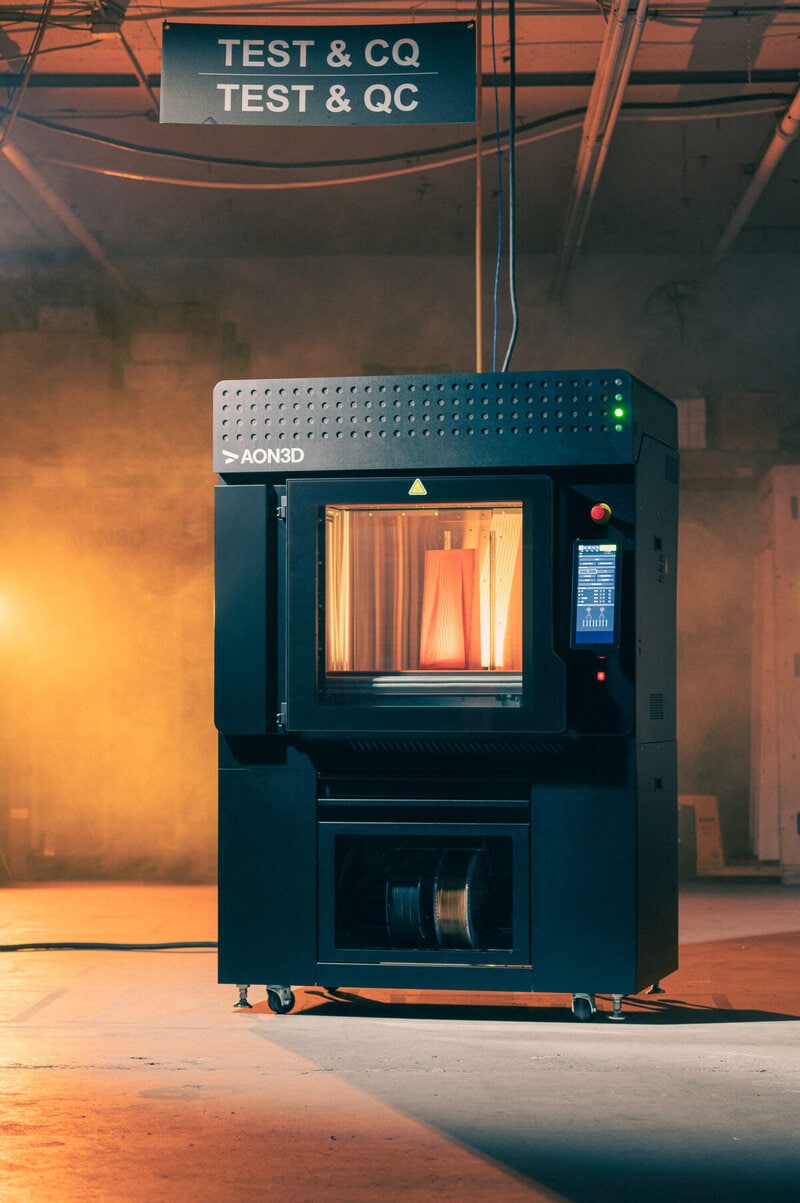
Bendix is using AON3D's Hylo Industrial 3D Printer so its Advanced Manufacturing Engineering team can make and revise production tooling in-house instead of waiting on outside shops. For the commercial vehicle supplier, that turns jig changes into quick floor tests while keeping high-heat plastics such as PEEK and Ultem in play.
Hylo pairs an open-material setup with Basis, an AI tuning program that analyzes each part and can simulate a build before it starts. Its nozzle reaches 500 °C, and the printed tooling meets a planarity target of 0.005 inches, giving the team durable fixtures with fewer failed builds.
Tooling that once ran $15,000 now lands near $600, and that shifts the value of the machine beyond prototyping. On Bendix lines where downtime can hit $10,000 an hour, faster repairs and replacement parts turn the Hylo into a hedge against expensive stoppages.
Image Credit: 3DPrint.com | Additive Manufacturing Business
Why This Trend Is Growing
- In-house Industrial Tooling
- Manufacturers are bringing fixture production closer to the line, creating room for faster design cycles, lower tooling costs, and reduced reliance on external machine shops.
- High-heat Additive Manufacturing
- Advanced printers that process PEEK, Ultem, and other engineering polymers expand additive manufacturing into durable production environments once reserved for machined metal or outsourced tooling.
- AI-guided Print Simulation
- Build-analysis software reduces trial-and-error in industrial 3D printing by improving part reliability, material performance, and first-pass success rates.
Industries Being Reshaped
- Commercial Vehicle Manufacturing
- Heavy-duty suppliers gain new flexibility from localized tooling and replacement part production that can limit costly downtime across high-throughput assembly lines.
- Industrial 3D Printing
- Open-material, high-temperature systems are shifting additive platforms from prototyping tools into operational assets for maintenance, repair, and production support.
- Advanced Manufacturing Software
- Simulation and automated tuning platforms are becoming critical enablers for complex polymer printing, improving consistency in demanding factory applications.