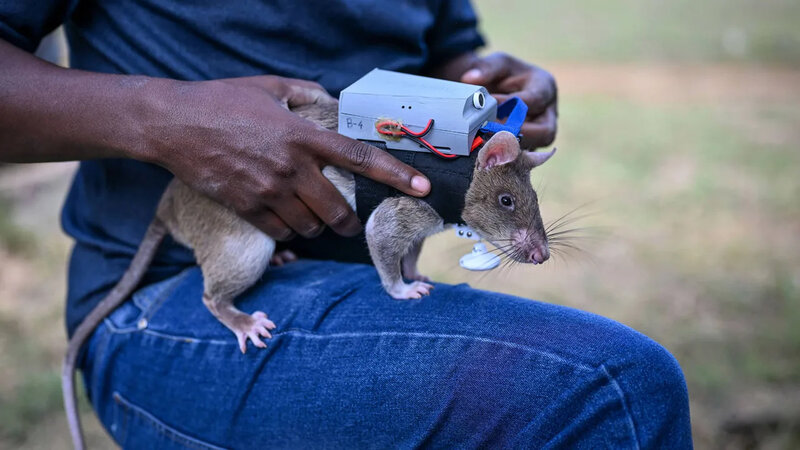
APOPO equips its African giant pouched 'RescueRATs' with backpacks that stream audio and video from voids inside collapsed buildings, giving rescue teams a way to check spaces that people and robots cannot safely reach. Built for earthquake and building-collapse response, the packs also support two-way communication with survivors.
The newest pack fits in a 3D-printed housing and weighs 100 grams or less, light enough for the animals to move over unstable debris without throwing off their balance. Its battery supports up to 35 minutes of streaming, and each trained rat tugs a pendant on the vest after locating a person.
Turkey operational trials place the system in an earthquake-prone setting, where faster checks of narrow rubble pockets can steer crews toward the likeliest rescue points sooner. With a second cohort now training in Tanzania, APOPO is building a hybrid search layer that adds animal mobility to conventional rescue work.
Image Credit: APOPO
What's Driving This Trend
- Biohybrid Search Systems
- Animal mobility paired with lightweight sensing introduces new models for reaching unstable, confined environments beyond the limits of drones and ground robots.
- Wearable Rescue Sensors
- Miniaturized packs with streaming, signaling, and communication features create room for specialized field devices designed around nonhuman first responders.
- Rubble Communication Networks
- Two-way audio and video links from void spaces expand how emergency teams verify survivor status and prioritize rescue operations in real time.
Who This Affects Most
- Emergency Response
- Search-and-rescue organizations gain alternative detection layers that can improve decision-making during earthquakes, collapses, and other high-risk disaster events.
- Wearable Technology
- Ultra-light connected hardware for animals points to emerging product categories in ruggedized wearables built for extreme operational settings.
- Robotics
- Hybrid approaches combining biological movement with digital sensing challenge fully mechanical rescue platforms and broaden the definition of autonomous field systems.