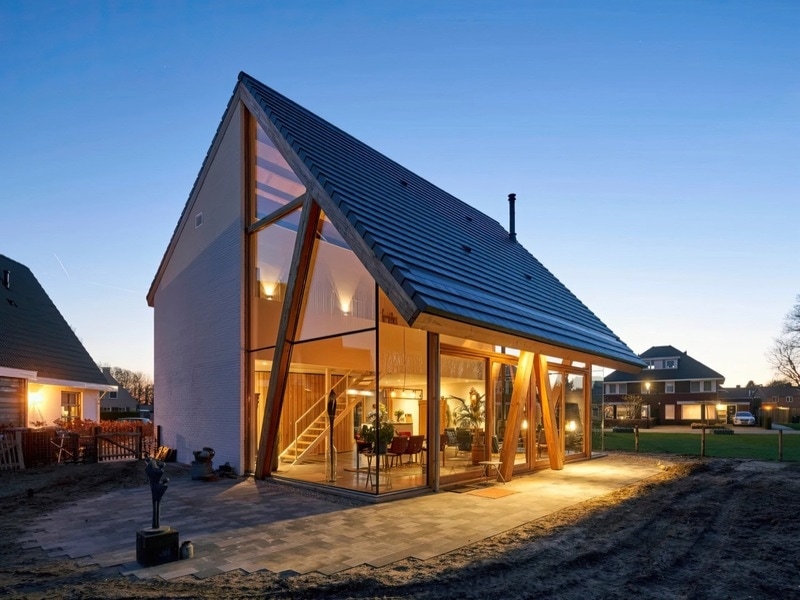
This Dutch Barnhouse by RV Architecture interprets a traditional agricultural form within a suburban setting by prioritising spatial continuity over enclosed rooms. While the exterior maintains a familiar pitched-roof profile, the interior is arranged as a sequence of connected spaces rather than a collection of separate rooms.
Living and dining areas unfold along the length of the house, with circulation paths replacing conventional corridors. Changes in ceiling height, floor level, and material subtly define zones without the use of walls or doors. Large glazed openings bring daylight deep into the plan and maintain visual connections with the surrounding landscape.
Service functions such as the kitchen, bathrooms, and storage are grouped toward the centre of the house to keep the perimeter open and flexible. Structural timber elements remain exposed, supporting the roof while contributing to the interior’s rhythm. A restrained palette of timber and concrete surfaces reinforces the home’s open, continuous spatial organisation.
Image Credit: Ruud Visser, Fumi Hoshino
Key Themes Behind This Trend
- Open-plan Residential Design
- Increasingly, residential architecture is embracing open-plan designs that seamlessly integrate different living areas, fostering a sense of continuity and flexibility.
- Natural Light Integration
- Strategically designed large glazed openings are emerging as a trend, allowing for optimal natural light penetration and creating stronger connections between indoor and outdoor environments.
- Multi-level Zoning Without Walls
- Innovative multi-level zoning techniques use changes in height and flooring to define spaces, offering a sophisticated alternative to traditional partition walls.
Where This Applies
- Sustainable Architecture
- Incorporating exposed structural timber and minimalistic material palettes aligns with sustainable architecture practices focused on resource-efficient and eco-friendly designs.
- Interior Design
- The shift towards integrating service functions centrally within open layouts is reshaping interior design approaches, enhancing home versatility and functionality.
- Construction and Building Materials
- Advanced construction techniques using timber and concrete can revolutionize how living spaces are built, emphasizing aesthetic appeal alongside structural integrity.