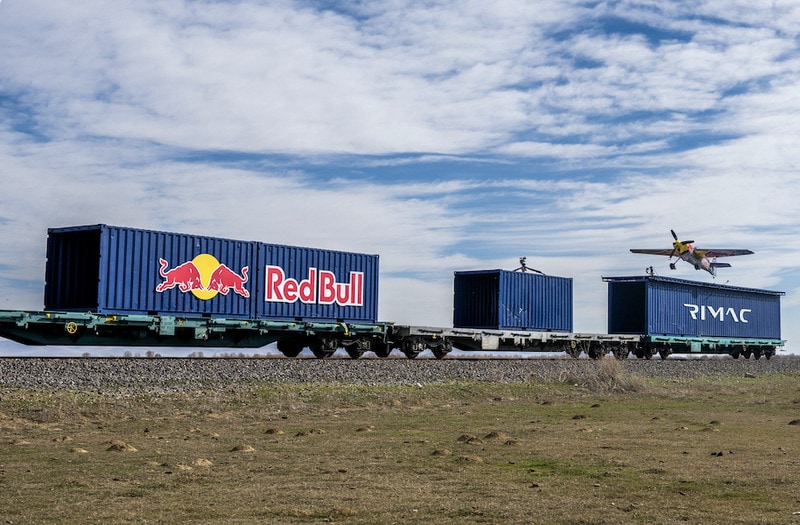
Red Bull, the energy drink brand renowned for its association with extreme sports and daring athletic feats, has announced that its athlete Dario Costa successfully completed a world-first aviation maneuver in which he landed a Zivko Edge 540 aircraft on a moving cargo train traveling at 120 kilometers per hour in Afyonkarahisar, Türkiye, before executing a vertical pull take-off from the same container.
The Italian pilot reduced his aircraft to a near-minimum controllable airspeed of 87 kilometers per hour to align with the train at its maximum operational speed. He completed the entire sequence of approach, blind landing, and take-off within a fifty-second window along a two and a half kilometer railway section. The landing was executed on the ninth cargo container, a platform that remained outside Costa's field of vision during the final approach due to the aircraft's attitude and the train's dimensions. Dario Costa's maneuver marks a historic achievement in applied aerodynamics and precision aviation.
Image Credit: Red Bull
What Makes This Trend Stand Out
- Precision Low-speed Aerodynamics
- New control techniques demonstrated at near-stall speeds reveal potential for aircraft designs that maintain maneuverability and stability in constrained urban or tactical environments.
- Mobile Platform Operations
- Executing landings and take-offs on moving infrastructure highlights opportunities for aircraft to operate from dynamic, non-traditional surfaces such as vehicles, ships, and railcars.
- Human-machine Hybrid Piloting
- High-stakes, short-window maneuvers showcase the value of integrated pilot-assist systems combining human judgment with real-time sensor autonomy for split-second decision contexts.
Sectors Adopting This
- Aerospace Manufacturing
- Advances in airframe and control-system design driven by extreme precision requirements point toward compact, highly controllable platforms for short-takeoff-and-landing and urban air mobility markets.
- Rail-integrated Logistics
- The concept of operating aircraft from moving trains suggests new multimodal solutions where aerial assets augment freight transfer, last-mile delivery, or mobile maintenance operations.
- Emergency Response Aviation
- Capabilities to land and launch from improvised or moving sites imply enhanced options for rapid disaster relief, medical evacuation, and frontline supply delivery in inaccessible areas.