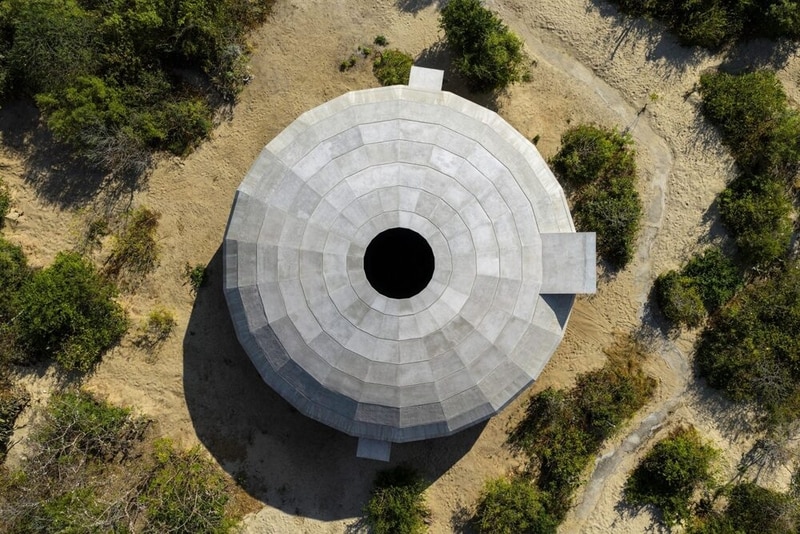
The Casa Wabi Mushroom Pavilion is a small research and community structure designed by OMA for the Casa Wabi arts foundation near Puerto Escondido, Mexico. The pavilion was created to support mushroom cultivation while also teaching local communities about growing fungi and sustainable food production. The building takes the form of a self-supporting oval concrete shell whose geometry was derived from the interior layout required for mushroom farming.
The domed interior is divided into three chambers dedicated to incubation, fruiting and storage, arranged around a central gathering space. Stepped seating along the walls doubles as shelving for terracotta mushroom pots produced by local artisans. An oculus above the center brings daylight into the cave-like interior, while perimeter openings provide natural ventilation. The curved concrete shell narrows at the base to reduce its footprint on the ground and preserve surrounding vegetation.
Image Credit: Rafael Gamo
Why This Trend Is Growing
- Biocentric Architectural Shells
- Curved, self-supporting forms that integrate environmental controls and material efficiency enable buildings to host living systems and reduce ecological footprints.
- Agricultural-educational Hybrids
- Multiuse structures that combine cultivation zones with communal learning spaces foster knowledge transfer alongside food production in underserved regions.
- Localized Fungal Economies
- Small-scale mushroom cultivation tied to artisanal supply chains and circular material use creates new local value loops for food, craft, and waste management.
Industries Being Reshaped
- Architecture and Design
- Form-finding techniques and climate-responsive shells open pathways for practice firms to develop low-impact, multifunctional community pavilions.
- Agritech and Mycology
- Advances in substrate optimization, modular incubation systems, and distributed production models are reshaping how fungi are farmed and commercialized.
- Community-based Education
- Place-based learning programs tied to hands-on cultivation create scalable frameworks for vocational training and local resilience building.