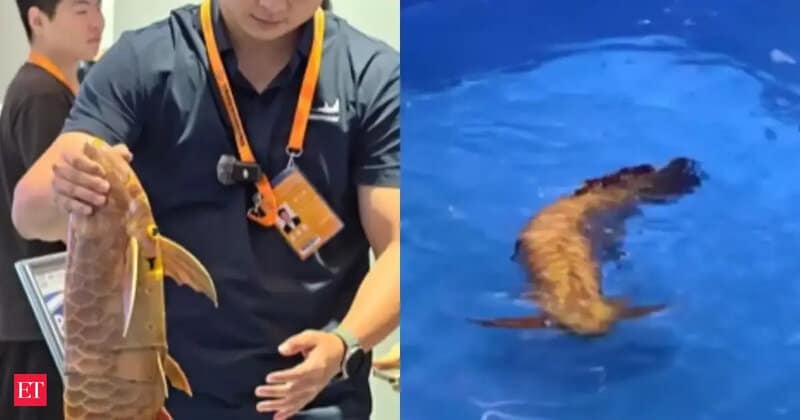
Boyagongdao Marine Technology Group created the BG-5 Golden Dragon Fish, a 3 kg, fish-shaped underwater robot that copies the form and motion of a golden arowana, featuring a flexible, multi-joint tail instead of a rotary propeller. The machine swims by producing undulating waves along a segmented tail, and onboard sensors let it steer around obstacles without following a fixed preprogrammed route. The dimensions listed are 640 mm in length, 204 mm in beam and 90 mm in height, and it is rated to operate down to 5 metres.
The tail assembly uses three primary joints split into seven segments to generate propulsion, yielding a top speed of about 0.6 metres per second. Boyagongdao also describes a BG-5V variant that adds automated path planning, task allocation, formation control and inter-robot cooperation for coordinated missions.
The BG-5's small, fishlike profile and autonomous navigation make it suited to confined or shallow-water tasks such as surveillance and reconnaissance where larger vehicles struggle. Its design points toward swarm-capable deployments that could let multiple compact robots divide work and cover areas cooperatively, expanding operational flexibility for marine sensing missions.
Image Credit: The Economic Times
What Makes This Trend Stand Out
- Biomimetic Marine Robotics
- Fish-inspired propulsion systems create quieter, more maneuverable underwater machines suited to sensitive surveillance, inspection and ecological monitoring contexts.
- Swarm Underwater Autonomy
- Coordinated fleets of compact robots introduce new possibilities for distributed sensing, cooperative reconnaissance and adaptive mission coverage in shallow marine environments.
- Propeller-free Aquatic Mobility
- Flexible tail-driven locomotion reduces reliance on traditional rotary propulsion, opening space for safer, stealthier and more energy-conscious underwater robot designs.
Sectors Adopting This
- Marine Defense
- Autonomous fishlike robots support low-profile reconnaissance and perimeter awareness in coastal, harbor and confined-water security operations.
- Ocean Technology
- Compact biomimetic platforms expand the toolkit for marine data collection, infrastructure inspection and underwater navigation in areas inaccessible to larger vehicles.
- Environmental Monitoring
- Quiet, agile robotic swimmers enable less intrusive observation of aquatic habitats, pollution zones and shallow ecosystems where conventional equipment may disrupt conditions.