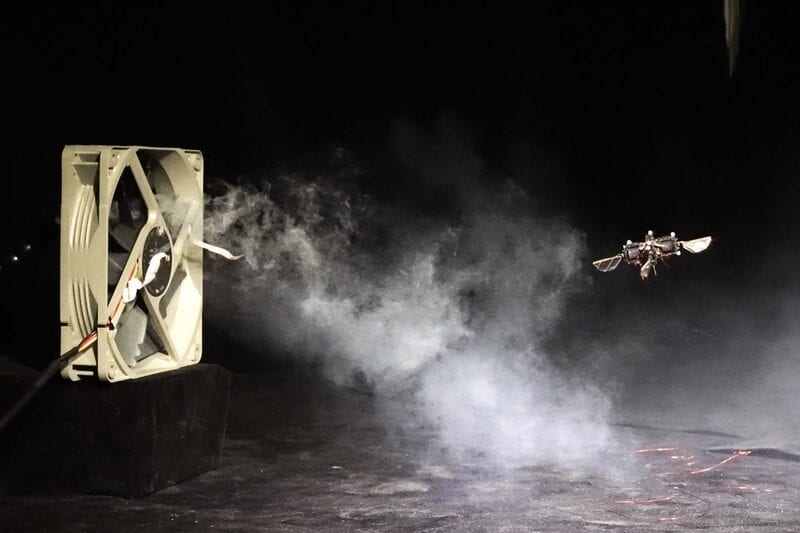
Researchers at the Massachusetts Institute of Technology (MIT) have developed a tiny robot that can fly rapidly by mimicking the wing movements and flight mechanics of a bumblebee. The robot measures only a few centimetres in length and employs flapping wings driven by lightweight actuators to generate lift and thrust. Its wing motion replicates the complex kinematics observed in bumblebee flight, enabling efficient manoeuvrability and speed despite the robot’s small scale. The design focuses on aerodynamic performance and energy efficiency, using rapid flapping and precise control to sustain flight in varied conditions.
Development of the robot involved detailed analysis of insect wing motion and the translation of these biological principles into engineered mechanisms. Lightweight structural components and advanced materials support the robot’s powertrain and contribute to overall flight stability. Control algorithms coordinate wing movement to adjust lift, direction, and balance, allowing the robot to navigate with precision. The project demonstrates how insights from natural flyers can inform the design of miniature aerial vehicles that combine agility with robust performance.
Image Credit: MIT
What Makes This Trend Stand Out
- Bio-inspired Robotics
- Integrating biological principles into robotic design creates fast, efficient machines with advanced maneuverability derived from natural flyers.
- Micro-aerial Vehicle Innovation
- The development of tiny flying robots marks a significant step forward in the miniaturization of aerial technology.
- Precision Control Systems
- Using control algorithms to replicate natural flight patterns introduces greater accuracy and stability in robotic flight dynamics.
Sectors Adopting This
- Drone Technology
- Advancements in miniature flying robots are reshaping the possibilities for small-scale, efficient drones for various applications.
- Materials Science
- Lightweight structural components and advanced materials are pivotal for enhancing flight stability and energy efficiency in micro-scale robotics.
- Artificial Intelligence
- Implementing AI-driven control algorithms in robotics can replicate complex natural systems, advancing movement precision and adaptability.