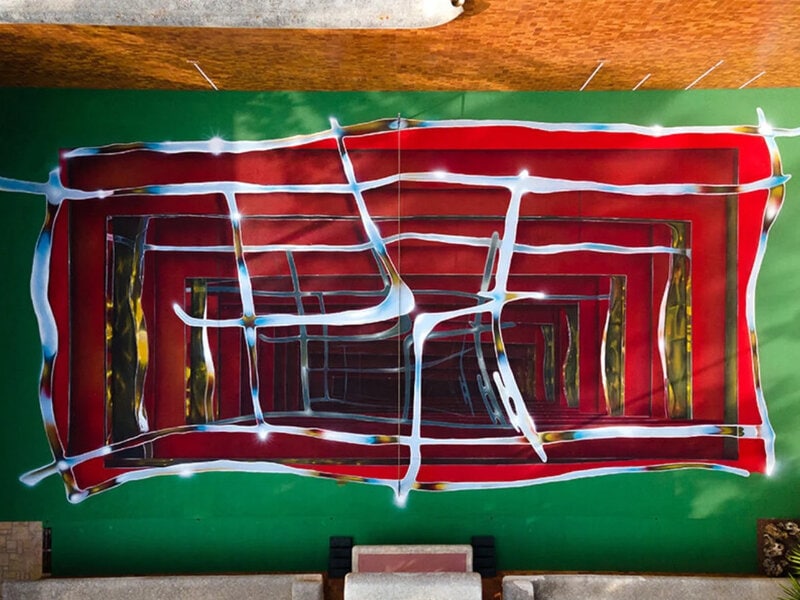
Spok Brillor painted 'Hard Court 2' at Casa Axis, a tennis court that read like a shifting canvas, featuring inward-stacked white lines, metallic gradients, and deep burgundy planes. The design tightened the court's markings into repeating rectangular planes, so the boundaries visually contracted and the surface read like an architectural shaft or a painted portal.
Hard Court 2 took twelve days to complete and was part of the 'Casa Axis International Open,' a tournament that tasked the outgoing winner with repainting the court before the next event. The first version, by Lucas Benarroch (MRKA), loosened the geometry into hand-drawn lines; Spok's iteration reversed that approach with reflective pale blue and yellow lines crossing the surface.
The project matters because it embeds change into the rules rather than relying on maintenance, turning a sports surface into an evolving artwork that players inherit. Tying transformation to competition keeps the court alive as a site-specific piece and reframes commissioning as ongoing stewardship.
Image Credit: Spok Brillor
What Makes This Trend Stand Out
- Rotating Sports Murals
- Athletic venues that change visually between events create fresh sponsorship inventory, cultural relevance, and collectible experiences around otherwise static infrastructure.
- Artist-led Competition Formats
- Tournament rules that assign creative stewardship to winners blend performance, authorship, and legacy into participatory entertainment models.
- Functional Art Courts
- Playable surfaces designed as immersive artworks signal opportunities for venues to merge recreation, public art, and destination-based tourism.
Sectors Adopting This
- Sports Venues
- Stadiums, courts, and clubs can evolve from fixed facilities into programmable visual platforms that refresh audience engagement seasonally.
- Public Art
- Commissioning models based on recurring transformation expand site-specific art beyond permanence, making change itself part of the cultural asset.
- Experiential Marketing
- Brand partnerships tied to evolving court designs offer high-visibility storytelling through spatial design, competition, and social media-ready spectacle.