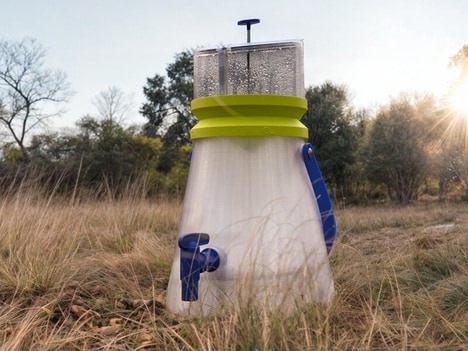
Technology company Aircela has just presented a unique machine in America that claims to produce gasoline from air. It was demonstrated in New York recently as the machine creates petrol by taking carbon dioxide collected through direct carbon capture and hydrogen that is from electrolysing water. This is a new approach to renewable energy because the amount of released carbon dioxide is the same as captured.
Aircela head of industrial design Liz White speaks about the design, "By designing compact, modular machines, we can produce fuel directly where it's needed, reducing transportation costs, simplifying logistics, and enabling production even in remote or hard-to-fuel locations. By producing many smaller units, we're able to drive down costs much faster than a traditional centralised plant would allow. This approach lets us scale manufacturing, continuously improve the technology, and bring fossil-free fuel to market more quickly and efficiently."
Image Credit: Aircela
Why This Trend Is Growing
- Carbon-capture Fuel Production
- The innovation in capturing carbon dioxide and converting it to gasoline initiates a sustainable approach to fuel production, potentially disrupting traditional fossil fuel industries.
- Distributed Energy Systems
- The move towards compact, modular fuel production units marks a shift from centralized energy plants, enabling local and remote energy innovation.
- Electrolytic Hydrogen Generation
- Utilizing water electrolysis to produce hydrogen for synthetic fuel generation highlights advancements in hydrogen technology and its applications.
Industries Being Reshaped
- Renewable Energy Technology
- Developing gasoline from air represents a novel sector within the broader push for sustainable and eco-friendly fuel alternatives.
- Logistics and Transportation
- Producing fuel near demand centers transforms logistics by reducing transportation costs and logistical complexity, presenting new challenges and efficiency opportunities.
- Hydrogen Production and Utilization
- The integration of small-scale electrolysis systems in fuel creation accentuates the growing importance of hydrogen as a key component in future energy solutions.