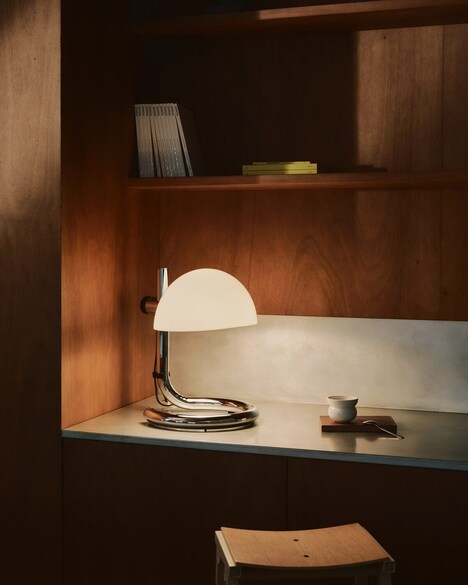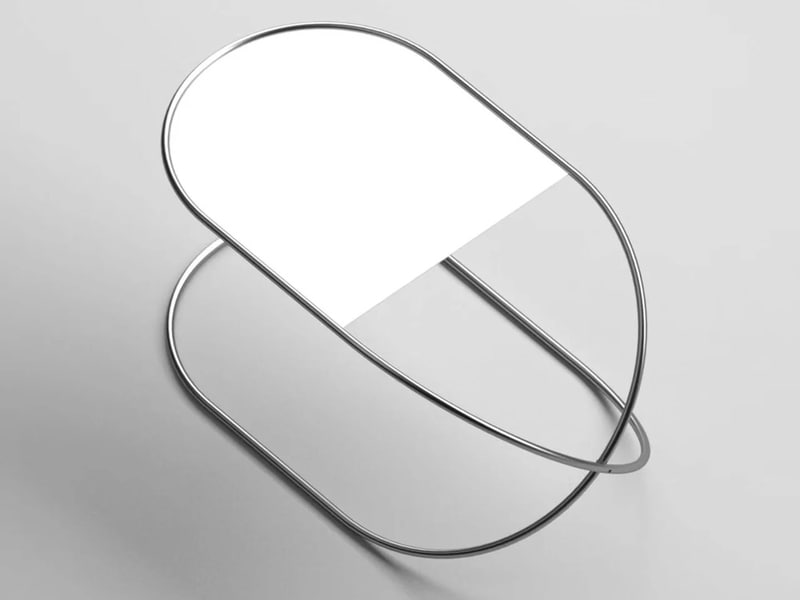
The Whisk table by Deniz Aktay is constructed from a continuous metal tube that is bent into shape to create both the base and support without additional components. The design uses controlled curvature to define stability, with the tube looping outward to form the ground contact before rising to hold the tabletop. This single-element approach removes the need for joints or separate legs, resulting in a lightweight, open structure.
The geometry is defined through smooth directional bends that balance the tabletop over a minimal footprint, creating a cantilevered effect while maintaining structural integrity. The tube maintains a consistent thickness throughout, emphasizing continuity across the form. The table is produced as part of Aktay’s exploration of single-material construction using bent tubular forms.
Image Credit: Deniz Aktay
What Makes This Trend Stand Out
- Single Element Construction
- A continuous component approach reduces part count and simplifies assembly, enabling products that rely on form-derived functionality rather than multiple fastened parts.
- Controlled Curvature Engineering
- Precision bending and curvature control allow structural stability to be encoded into geometry, creating opportunities for load-bearing forms that replace traditional frameworks.
- Material Continuity Aesthetics
- Emphasizing uninterrupted surfaces and consistent cross-sections fosters designs that communicate strength and lightness while minimizing visible joins and seams.
Sectors Adopting This
- Furniture Manufacturing
- Streamlined production of bent-tube pieces can disrupt modular assembly lines by delivering lightweight, low-part-count products that blend structural function with sculptural form.
- Architectural Components
- Facade and interior structural elements derived from continuous-bent profiles can enable new load-bearing cladding and support systems with reduced connection hardware.
- Medical Device Fabrication
- Single-piece tubular components have the potential to replace multi-part instrument frames and supports, offering sanitizable, robust forms with fewer failure points.