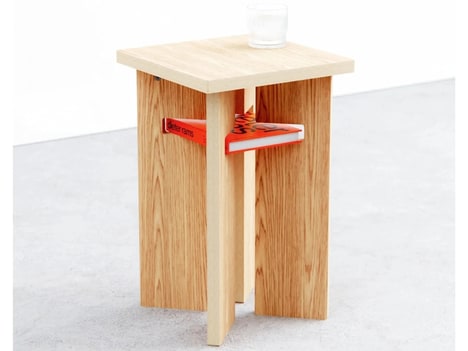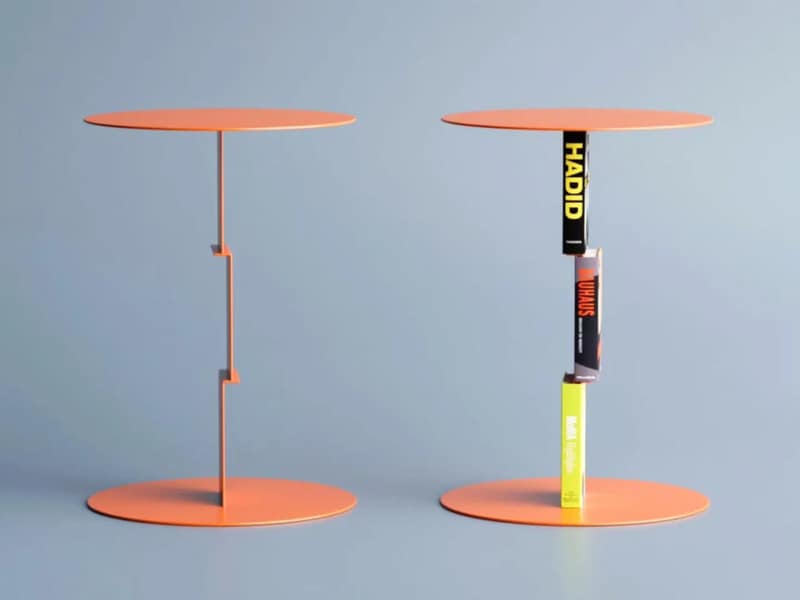
Deniz Aktay’s Delusion Table presents a side table designed to make books appear as the primary structural support. The Delusion Table uses a concealed metal framework that connects the tabletop to the base, while integrated clips hold books vertically along the central column. Once books are inserted, the structural core becomes visually obscured, creating the impression that stacked volumes are carrying the surface above through their own weight and alignment.
Aktay’s system secures each book through internal supports that grip pages while leaving spines exposed, forming a continuous stacked arrangement. The table’s proportions are calibrated to standard book dimensions, allowing consistent spacing and stability across different sizes. Material finishes remain minimal to reduce visual interference, keeping attention on the books themselves. The structure functions as a single unit, where display and support are combined through concealed engineering rather than visible framing.
Image Credit: Deniz Aktay
What Makes This Trend Stand Out
- Book-as-structure Furniture
- Designs that make everyday objects like books appear to function as primary load-bearing elements suggest new product categories blending utility and narrative display.
- Concealed Structural Engineering
- Hidden frameworks that create visual illusions of unsupported forms point to engineering approaches prioritizing aesthetic minimalism alongside safety and modularity.
- Hybrid Display-support Design
- Objects that combine exhibition and structural roles indicate opportunities for integrated systems where exhibited items become part of the product’s mechanical function.
Sectors Adopting This
- Furniture Manufacturing
- Manufacturers could pivot toward products that fuse decorative collections with load-bearing components, challenging conventional assembly and finishing processes.
- Interior Design and Staging
- Design professionals may increasingly adopt pieces that double as visual storytelling devices and structural elements, reshaping spatial narratives in commercial and residential projects.
- Publishing and Book Retail
- Retailers and publishers might explore merchandise and in-store fixtures that treat books as functional elements, altering presentation strategies and consumer engagement.