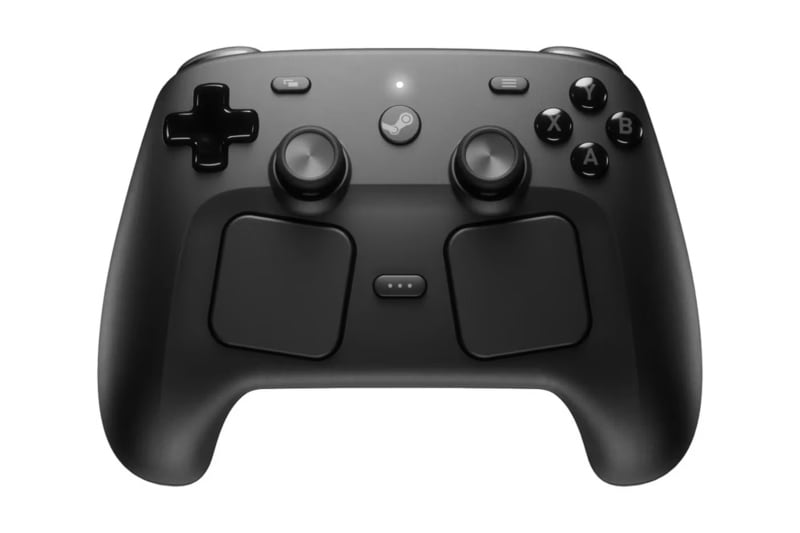
The Valve Steam Controller 2 is a redesigned gamepad built for PC gaming, combining traditional inputs with touch-based controls. The Valve Steam Controller 2 features dual thumbsticks, a standard D-pad, and two haptic trackpads, allowing users to simulate mouse-like precision alongside conventional gameplay inputs. It also includes a gyroscope and four programmable rear grip buttons, supporting customizable control schemes across different game types.
The controller launches on May 4, 2026, priced at $99 USD and sold directly through Steam. It connects via Bluetooth, USB-C, or a dedicated low-latency wireless dongle, with battery life exceeding 30 hours per charge. Designed to integrate closely with the Steam ecosystem, it supports extensive remapping and configuration profiles, including compatibility with non-Steam titles through software. The device is part of Valve’s broader 2026 hardware lineup, alongside the Steam Machine and Steam Frame VR headset.
Image Credit: Valve
Why This Trend Is Growing
- Hybrid Input Interfaces
- Emerging controllers that combine analog sticks, buttons, gyroscopes and touch surfaces create new input paradigms that can blur the line between gamepad and mouse precision.
- Haptic Trackpad Integration
- Haptic trackpads providing tactile feedback alongside touch sensing enable more precise cursor-like control and nuanced in-game interactions without traditional peripherals.
- Ecosystem-centric Hardware
- Close integration with platform ecosystems and configurable software profiles allows hardware to act as a gateway for cross-title compatibility and persistent user preferences.
Industries Being Reshaped
- PC Gaming Peripherals
- Manufacturers of mice, keyboards and controllers face potential disruption as single devices begin to replicate the functionality of multiple dedicated peripherals.
- Cloud Gaming Platforms
- Cloud streaming services could be reshaped by low-latency, multi-protocol controllers that standardize input across local and streamed sessions, altering client-device expectations.
- VR-AR Hardware
- Immersive hardware firms may see opportunities as hybrid controllers with precision touch and haptics become input bridges between flat-screen titles and spatial experiences.