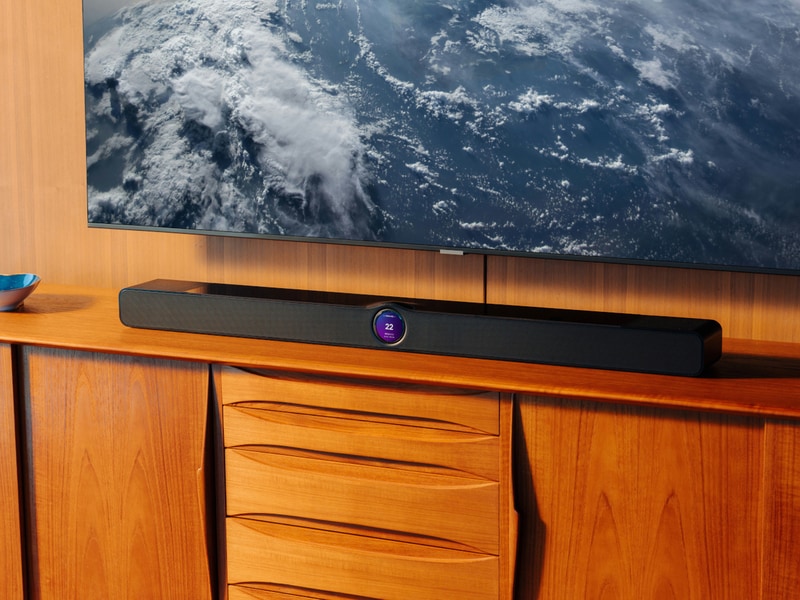
WiiM Bar is the company's first soundbar and combines Dolby Atmos audio with an integrated touchscreen interface. A 2.1-inch circular display is positioned at the center of the front panel, providing access to album artwork, playback information, EQ settings, Smart Presets, and clock displays. The touchscreen allows users to control music, switch sources, and adjust audio settings directly from the device. The soundbar uses a 3.0.2-channel configuration with three mid-woofers, three tweeters, two upward-firing drivers, and four passive radiators designed to enhance bass performance.
The system supports Dolby Atmos playback and delivers up to 135 watts of output through HDMI eARC, optical, line-in, and USB audio connections. RoomFit automatic calibration adjusts sound based on room acoustics, while Clear Voice processing enhances dialogue clarity and Night Mode optimizes lower-volume listening. Additional WiiM products can be connected wirelessly to create a 5.1.2 surround sound setup. T
Image Credit: WiiM
What Makes This Trend Stand Out
- Integrated Touchscreen Audio Interfaces
- Built-in touch displays on audio devices create new user interaction models that could displace traditional remote and app-based control paradigms.
- Spatial Audio with Smart Calibration
- Room-adaptive calibration and Dolby Atmos support enable personalized 3D sound experiences that may redefine expectations for home audio realism.
- Modular Wireless Surround Systems
- Interoperable wireless components that scale from stereo to 5.1.2 configurations offer flexible deployment options that challenge fixed, single-piece sound system designs.
Sectors Adopting This
- Consumer Electronics
- Converging tactile displays with high-fidelity audio components could prompt a shift toward multifunctional living-room devices that replace separate AV equipment.
- Home Entertainment
- Enhanced dialogue processing and immersive audio formats present opportunities for differentiated content experiences that alter content production and distribution norms.
- Smart Home Automation
- Audio systems with integrated displays and networked calibration features are positioned to become central nodes in connected-home ecosystems that blur the line between speakers and control hubs.