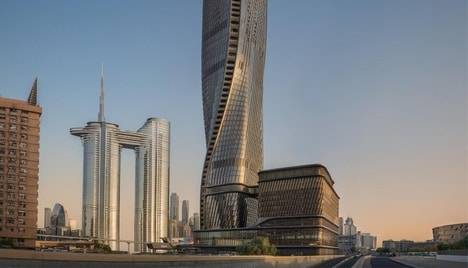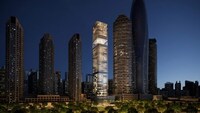
‘La Tour F’ is a 76-story supertall skyscraper currently nearing completion in the administrative district of Abidjan, the capital city of Cote d'Ivoire in west Africa.
With a height of 421 meters when including its spire, this supertall skyscraper is built around a reinforced concrete core and uses a double-layer glass façade that provides shading and weather protection while shaping its distinctive exterior. A defining aspect is its symmetrical, faceted form, which takes inspiration from the design of a traditional mask.
In terms of use, the supertall skyscraper is designed primarily for government offices, along with conference areas, restaurants and public spaces. The building also includes a glass-enclosed observation space at the top, accessible by a panoramic elevator.
This project reflects a broader move toward vertical development in dense city centers, with large-scale towers bringing multiple services into a single structure while reshaping the city skyline.
Image Credit: PFO Africa
Why This Trend Is Growing
- Mask-inspired Architectural Forms
- The integration of cultural motifs into faceted, protective exteriors points to buildings that marry symbolic identity with structural expression and climate responsiveness.
- Vertical Civic Hubs
- The concentration of government offices, public spaces and commercial functions within a single supertall tower indicates a move toward multilayered civic ecosystems that redefine urban service delivery and land use.
- Double-layer Façade Climate Control
- The adoption of double-skin glass envelopes combined with shading strategies suggests façade systems capable of significantly lowering energy consumption while permitting expansive glazed surfaces.
Industries Being Reshaped
- Supertall Construction Engineering
- Advances in reinforced concrete cores and high-rise structural systems imply opportunities for novel construction methodologies that shorten timelines and manage wind and seismic loads more efficiently.
- Urban Planning and Civic Services
- The shift toward centralized vertical government hubs signifies potential for reimagined service delivery models and governance frameworks adapted to dense, high-rise contexts.
- Advanced Façade and Glazing Manufacturing
- Demand for climate-adaptive, double-layer glazing and complex faceted panels points to scalable manufacturing solutions and integrated systems that couple aesthetics with thermal performance.