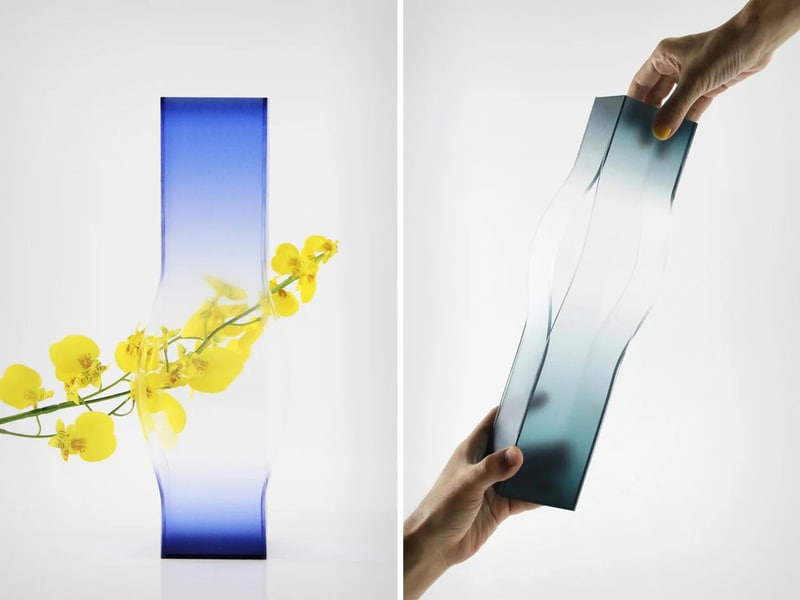
The Stretch Color vases by Bo Zhang are a series of sculptural vessels that use gradient color to shift between two-dimensional illusion and three-dimensional form. Created through layered acrylic and spray coloration, each piece transitions from dense pigment to full transparency, causing parts of the object to visually dissolve. From certain angles, the vases flatten into painterly surfaces, while slight movement restores their volume, creating a continuous shift between image and object.
The effect is driven by color rather than structure, where saturated tones anchor the form, and fading edges disperse it into the surrounding space. This produces areas that appear to disappear without any physical removal, leaving only partial outlines that challenge spatial perception. The series is produced in three sizes, each altering how the gradient stretches across the surface, from tighter compositions to more elongated visual transitions.
Image Credit: Bo Zhang
Key Themes Behind This Trend
- Gradient Surface Minimalism
- Shifts between saturated pigment and transparency create surfaces that read as both graphic planes and volumetric objects, enabling products that blur decorative image and functional form.
- Perceptual Material Design
- Materials engineered to dissolve visually through color transitions produce pieces whose perceived geometry depends on viewpoint, suggesting objects that reconfigure user perception without moving parts.
- Dynamic Visual-object Hybrids
- Forms that alternate between two-dimensional and three-dimensional readings under slight motion point to a category of hybrid artifacts that change role from artwork to utility as observers shift.
Where This Applies
- Home Decor
- Decor items employing gradient translucency can transform room dynamics by appearing to recede or assert presence, offering new ways to modulate spatial atmosphere and perceived scale.
- Gallery and Exhibitions
- Exhibition practices that showcase pieces with viewpoint-dependent visibility open possibilities for curatorial narratives that pivot on perceptual surprise and temporal engagement.
- Augmented Reality Product Design
- Virtual layering of color-to-transparent transitions can simulate shifting form perception in digital prototypes, enabling product concepts that adapt their apparent structure across viewing contexts.