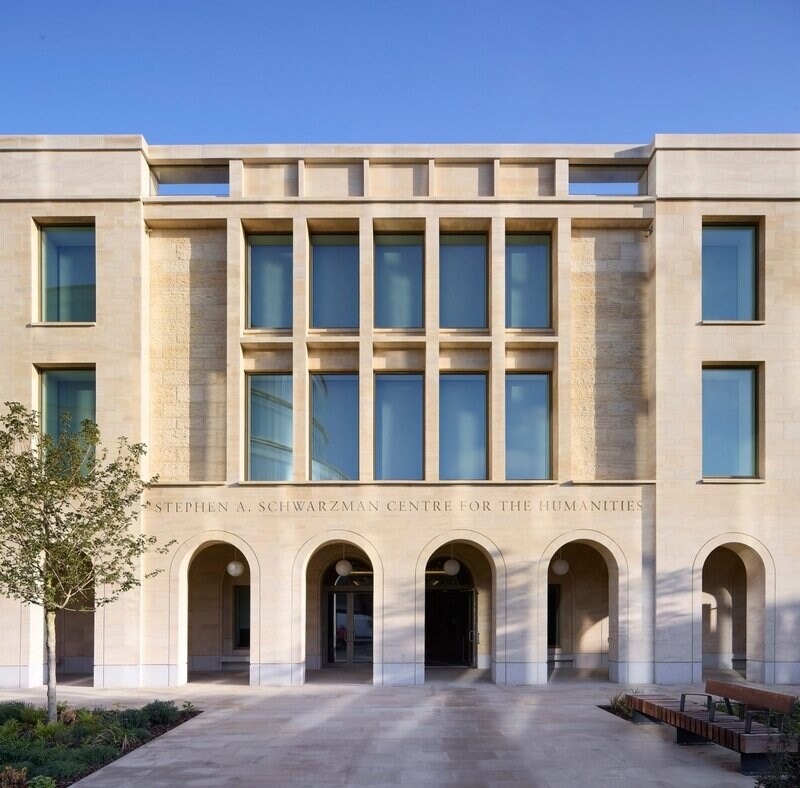
The Stephen A. Schwarzman Centre for the Humanities is a monumental work by Hopkins Architects that unites seven humanities faculties under one roof. The design combines civic ambition, public accessibility, and sustainability in a landmark intended to serve both the university and the wider community. Clad in Clipsham limestone and cream brickwork, the structure respects Oxford’s historic fabric while projecting a contemporary identity.
At its heart, a vast central atrium topped by a dome connects exhibition halls, lecture theatres, concert venues, and teaching spaces. The colonnaded facades orient the building toward the Radcliffe Observatory and Somerville College, reinforcing a sense of place within the city. Passive design strategies including high insulation, electric-only systems, and rooftop solar position the building close to Passivhaus standards. The project redefines academic infrastructure by placing cultural performance and public engagement alongside scholarship.
Image Credit: Hufton + Crow
Key Themes Behind This Trend
- Integrated Academic Spaces
- Architectural designs are increasingly merging various academic disciplines into single, multifunctional spaces, fostering collaboration and interdisciplinary learning.
- Cultural-centric Campus Designs
- Modern academic buildings are evolving to emphasize cultural performance and public engagement, enhancing their role as community hubs.
- Sustainable University Architecture
- Universities are prioritizing eco-friendly construction methods like high insulation and renewable energy systems to meet sustainability standards, shaping the future of educational infrastructure.
Where This Applies
- Architecture and Design
- The convergence of advanced design techniques with traditional aesthetics is transforming how new academic buildings respect historical context while offering modern functionality.
- Renewable Energy Solutions
- The increasing integration of solar panels and electric-only systems in institutional buildings is driving the renewable energy industry towards innovative applications in urban environments.
- Higher Education
- Higher education institutions are redefining their campus infrastructure by creating spaces that equally prioritize public accessibility, scholarly pursuits, and environmental sustainability.