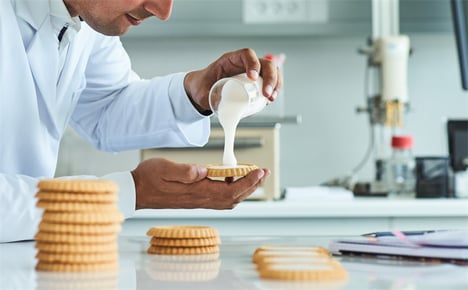

Seprify, a Swiss spinout from Cambridge and the University of Fribourg, launched a suite of cellulose-based whitening ingredients designed to replace titanium dioxide, featuring microstructured cellulose particles that scatter light to create whiteness and UV-boosting without pigment. The company announced a €13.4 million Series A to scale production and move from pilot validation to industrial supply, with Inter IKEA Group among the strategic investors.
Seprify released three product grades: SilvaAlba for food, SilvaLuma for suncare SPF boosting, and SilvaFolia for coatings and inks, all derived from FSC-certified virgin wood pulp and engineered at commercial readiness levels. For manufacturers, these ingredients offer a route to meet regulatory bans on TiO2 while maintaining optical performance; the cellulose approach also aims to cut CO2 emissions versus conventional titanium dioxide and fit into existing production workflows.
Image Credit: Seprify
What's Driving This Trend
- Bio-based Optical Additives
- Emergence of cellulose microstructures enabling pigment-free whitening and UV-boosting presents potential to redefine formulation strategies across product categories.
- Titanium Dioxide Replacement
- Regulatory-driven removal of TiO2 paired with equivalent optical performance creates openings for alternative materials to displace legacy white pigments.
- Sustainable Ingredient Scaling
- Investment-backed progression from pilot validation to industrial supply signals capacity for low-carbon, FSC-certified wood-pulp inputs to become mainstream commodity ingredients.
Who This Affects Most
- Food Processing
- Adoption of cellulose-based whiteners for food-grade applications could enable compliant formulations that preserve desired appearance without titanium dioxide.
- Personal Care-suncare
- SPF-boosting cellulose particles offer prospects for sun care products that enhance UV performance while avoiding pigment-related regulatory constraints.
- Coatings and Printing Inks
- Pigment-free light-scattering additives have the potential to deliver whiteness and opacity in coatings and inks with lower CO2 footprints and compatibility with existing production workflows.