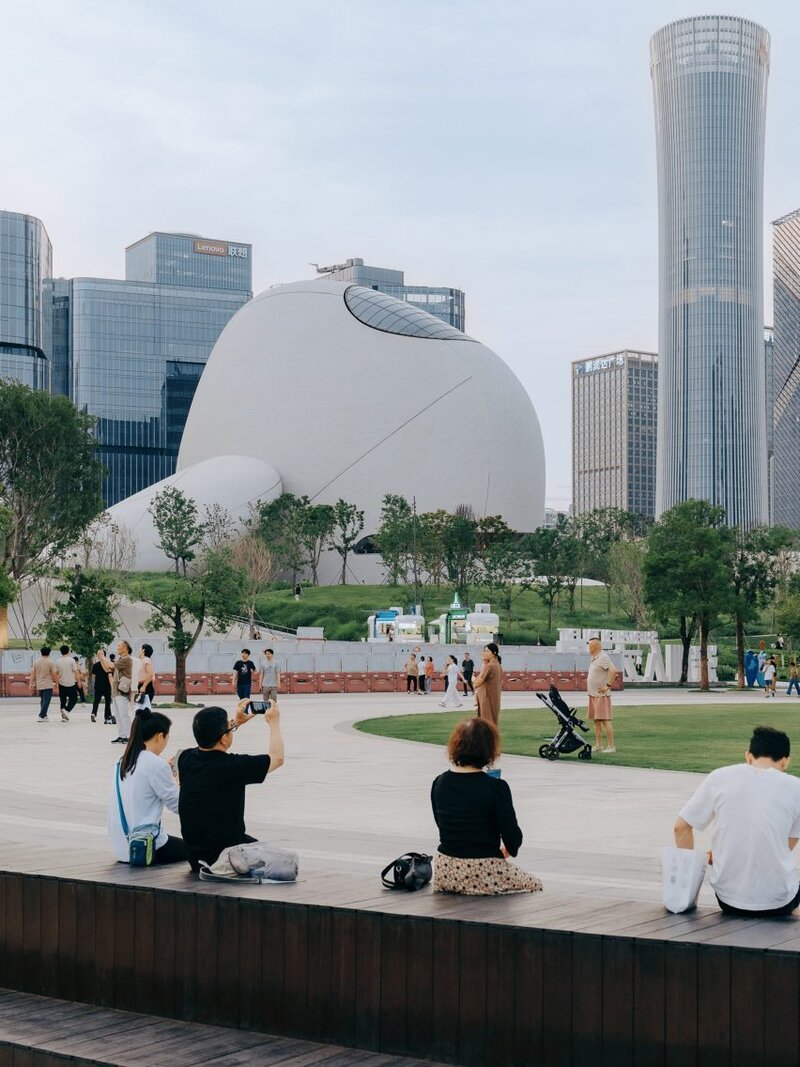
Shenzhen Bay Culture Square is a cultural complex by MAD in Shenzhen's Nanshan District that combines exhibition galleries, education facilities, a design library, and a multifunctional theatre beneath an undulating landscaped roof. Positioned between the city's skyline and Talent Park, the museum embeds much of its architecture below ground, allowing visitors to move across the site through winding green pathways that connect the urban environment with the waterfront. Granite-clad volumes resembling weathered boulders emerge above the landscape, housing key gallery spaces while maintaining a low profile within the surrounding coastal setting.
The subterranean interiors expose the building's concrete structure, with rooflights and a ring-shaped atrium introducing natural daylight into the galleries below. A central reflecting pool and outdoor plaza provide space for performances, festivals, and public events, while native planting extends across the roof and transitions toward the adjacent wetlands. The building's reduced height also minimizes interference with migratory birds traveling along the East Asian–Australasian Flyway
Image Credit: MAD
What's Driving This Trend
- Subterranean Cultural Spaces
- Underground galleries and civic venues create room for dense urban cultural programming while preserving surface-level public landscapes and skyline views.
- Living-roof Architecture
- Green roofs that function as walkable parks, habitat corridors, and climate buffers introduce new possibilities for blending infrastructure with ecological performance.
- Low-impact Waterfront Design
- Coastal cultural developments with reduced building heights and native planting support public access while limiting disruption to wetlands and migratory wildlife.
Who This Affects Most
- Architecture
- Landscape-integrated buildings expand the role of architects in creating civic destinations that merge structural design, ecology, and public circulation.
- Museums and Galleries
- Cultural institutions gain new formats through hybrid complexes that combine exhibitions, education, libraries, and performance spaces within immersive environmental settings.
- Urban Planning
- City districts can be reshaped by public complexes that connect parks, waterfronts, and cultural amenities through continuous pedestrian landscapes.