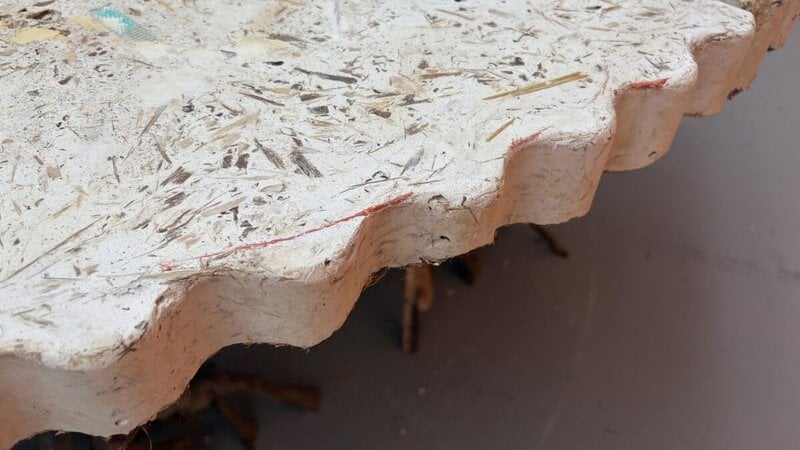
Harvest Moon table is a collaborative project by architect Charles Holland, academic Catharine Rossi, and design studio Local Works, fabricated entirely from materials harvested within a 40-mile radius of Canterbury, England. The table combines cast chalk, chestnut timber, apple tree wood, bark, and agricultural waste including baling twine and pallet straps to investigate regional biomaterials and localized production. Its chalk tabletop is cast around a chestnut frame with embedded apple wood reinforcement, creating a lightweight shell construction finished with terrazzo-like inclusions of bark, wood chippings, and other natural materials.
Apple tree branches form the table legs, while chestnut pegs and apple wood tools were also produced locally for assembly. Designed as a travelling research project, the table can be dismantled, transported, and reconstructed through public gatherings that emphasize collective participation. An accompanying publication includes assembly drawings, hosting guidance, essays, and a musical score that evolves as the table is reassembled in different locations.
Image Credit: Charles Holland
Key Themes Behind This Trend
- Hyperlocal Biomaterials
- Regional sourcing of chalk, timber, agricultural waste, and other nearby resources points to new product ecosystems built around place-based material intelligence and reduced supply-chain dependence.
- Participatory Furniture
- Dismantlable objects that are assembled through public gatherings reveal how furniture can become a social platform for community engagement, education, and cultural programming.
- Material Storytelling
- Designs paired with publications, scores, and assembly rituals show potential for products to carry evolving narratives that increase emotional value and public interest.
Where This Applies
- Sustainable Furniture
- Locally harvested components and lightweight natural constructions suggest fresh pathways for low-impact tables, seating, and interiors with region-specific aesthetics.
- Architecture and Design
- Collaborations between architects, academics, and studios demonstrate how built-environment practices can prototype circular material systems at an accessible object scale.
- Cultural Events
- Travelling research objects that are reconstructed in different locations create opportunities for museums, festivals, and civic venues to merge design display with participatory experience.