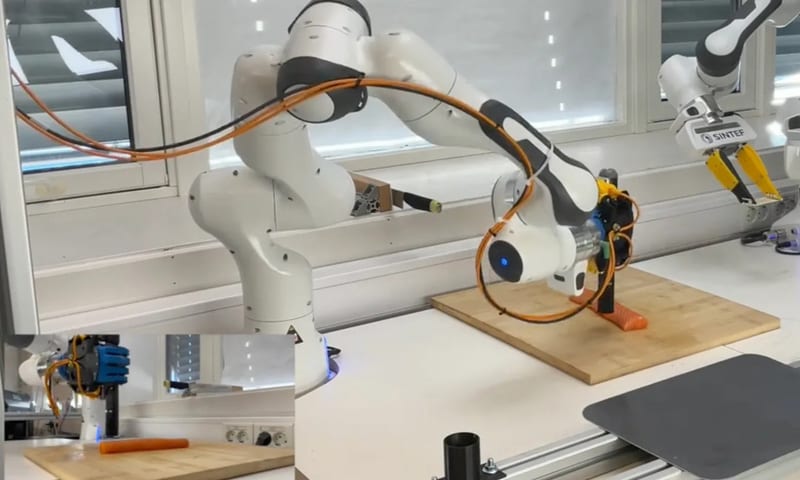
Robots have proven remarkably capable across a wide range of industrial tasks, yet it's often the most delicate operations that require precision and sensitivity that present the greatest engineering challenges, as seen in Sashimi-Bot, a three-armed robot created by a team at the Norwegian University of Science and Technology. This robot was specifically developed to prepare sashimi from cuts of salmon and cod, without the need for chef oversight.
Sashimi-Bot gets to work by employing each arm for a different task. While one stabilizes and positions the salmon on the cutting board, the second wields a chef’s knife for slicing, and the third retrieves finished slices and sets them on a serving tray. Uniquely, this robot was trained with deep reinforcement learning inside a virtual simulation, which involved practiced movements and trial and error, without real fish.
Key Themes Behind This Trend
- Autonomous Seafood Preparation
- Delicate fish slicing performed without chef supervision signals new potential for consistent premium food preparation in restaurants, markets, and commissary kitchens.
- Simulation-trained Kitchen Robots
- Virtual reinforcement learning reduces dependence on costly physical ingredients while enabling robots to master fragile, high-precision culinary tasks.
- Multi-arm Culinary Automation
- Coordinated robotic arms that stabilize, cut, and plate food introduce fresh possibilities for automating workflows once reserved for skilled human specialists.
Where This Applies
- Foodservice
- Restaurants and catering operators gain a pathway to standardized artisanal preparation as robots replicate complex chef techniques with repeatable accuracy.
- Seafood Processing
- Automated sashimi cutting creates opportunities for higher-value seafood products with reduced labor variability and improved portion consistency.
- Robotics
- Human-like manipulation of soft, perishable materials expands the commercial frontier for robotic systems beyond factories into sensory, craft-oriented environments.