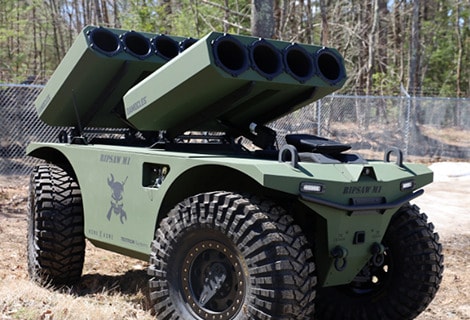
The 'Ripsaw M1' is a wheeled robotic vehicle, developed by Textron Systems, that aims to tackle challenges faced by marine corps by providing advanced reconnaissance.
Built to move ahead of crewed units, this particular robotic scout vehicle is intended to enter contested or uncertain areas first, transmitting data while reducing direct exposure for human personnel. The platform departs from earlier designs by using a wheel-based configuration suited to beaches, shallow water and uneven coastal ground. Its compact frame supports modular payloads, allowing sensors, counter‑drone systems or other mission hardware to be installed.
Electric all‑wheel drive enables both fast and low‑noise movement, with the inclusion of remote and autonomous control functions allowing the vehicle to quickly and easily maneuver through hazardous environments without being spotted.
Ultimately, this robotic vehicle is designed to be able to provide reliable reconnaissance and tactical risk reduction.
Image Credit: Textron Systems
What's Driving This Trend
- Autonomous Coastal Reconnaissance
- Robotic wheeled scouts optimized for beaches and shallow water are shifting reconnaissance patterns by allowing sustained forward sensing in contested littoral zones with minimized human risk.
- Modular Mission Payloads
- Compact platforms that accept swappable sensors, counter‑drone systems and mission packs are enabling rapid role changes and mission tailoring across diverse operational scenarios.
- Silent Electric Mobility
- Electric all‑wheel drive systems that prioritize low acoustic signatures and high maneuverability are transforming how unmanned vehicles approach stealthy forward operations.
Who This Affects Most
- Defense and Security
- Emerging robotic scouts are reshaping tactical doctrines by permitting risk reduction for personnel and expanding options for remote intelligence collection in contested environments.
- Maritime Surveillance
- Shoreline‑capable autonomous vehicles are altering coastal monitoring capabilities by providing persistent, low‑profile presence across beaches, estuaries and shallow waters.
- Robotics and Sensor Integration
- Interoperable modular architectures are driving new business models around payload customization, sensor fusion and rapid field reconfiguration for mission‑specific deployments.