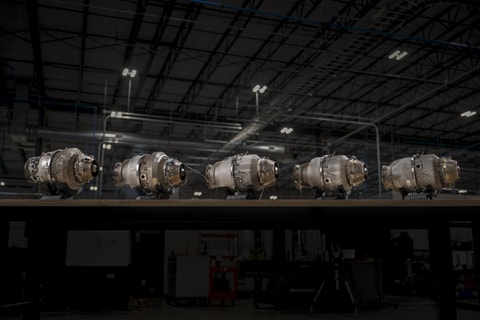
Beehive Industries introduced the Frenzy line of low-cost, 3D-printed turbojets and secured a nearly $30 million U.S. Air Force contract to advance testing, integration and qualification, featuring additive-manufactured components designed for rapid production. The award funds work on the lead Frenzy 8, a 200 lb-thrust engine, and prototype fabrication and optional follow-on work for the smaller Frenzy 6, a roughly 100 lb-thrust model.
The program covers vehicle integration, flight testing and prototype deliveries; Beehive completed high-altitude lab testing on the Frenzy 8 in December and previously delivered two prototypes to the Air Force in 2025. Funding comes from the Air Force’s Small Expendable Turbine program, aimed at qualifying low-cost, disposable turbines for uncrewed systems and stand-off weapons.
For military and industrial buyers, Beehive’s approach promises faster scaling and reduced supply-chain complexity by consolidating parts via additive manufacturing, potentially enabling higher-volume propulsion production. If flight campaigns and qualification succeed, the company plans low-rate production across multiple U.S. facilities to meet early orders.
Image Credit: Beehive Industries
Key Themes Behind This Trend
- Additive-manufactured Propulsion
- A transition to 3D-printed engine components presents the potential to consolidate parts and shorten development cycles, fundamentally changing cost and design flexibility in propulsion systems.
- Low-cost Disposable Turbines
- The emergence of inexpensive, expendable turbojets signals a move toward lower-cost mission architectures for uncrewed and munition-class platforms, reshaping procurement and lifecycle economics.
- Distributed Aerospace Production
- Localized, low-rate manufacturing across multiple facilities indicates a shift from centralized supply chains to regionally scalable production models that can accelerate responsiveness and reduce logistical complexity.
Where This Applies
- Defense Uncrewed Systems
- Uncrewed air systems may benefit from affordable, mission-tailored propulsion that lowers per-unit costs and enables new operational concepts for expendable or short-duration platforms.
- Commercial Aviation Manufacturing
- Aerospace OEMs and tier suppliers could see opportunities to adopt additive propulsion parts for niche aircraft and auxiliary power units, altering inventory and certification strategies.
- Supply Chain and Manufacturing Services
- Service providers focused on additive production and rapid prototyping stand to influence lead times and supplier consolidation by offering integrated fabrication and qualification capabilities.