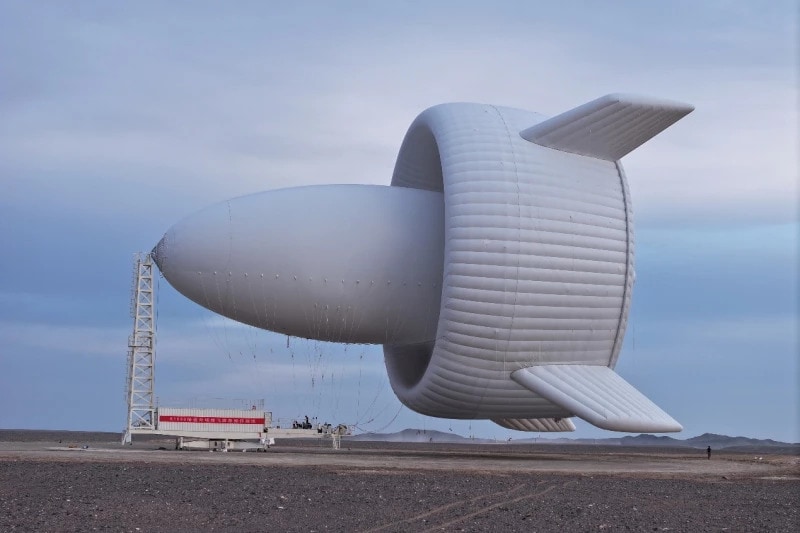
The S2000 SAWES is a 20,000 m3 helium-filled aerostat developed by Beijing-based Linyi Yunchuan Energy Technology, featuring 12 integrated turbines designed to generate electricity at around 2,000 m altitude. The system recently completed a test flight in Yibin, China, and transmitted generated power to the local grid via a tethered cable.
Measuring roughly 60 × 40 × 40 m, the S2000 combines lightweight inflatable structure with onboard generation hardware and a tether that carries electricity to shore. It rose without propulsion, required no tower or heavy foundations, and the developer reported the flight produced about 385 kWh; the full system is rated at 3 MW. Deployment is compact enough for standard containers and was completed in hours during the trial.
For consumers and operators the SAWES highlights faster, lower-footprint wind deployment and access to steadier high-altitude winds, enabling uses from temporary disaster relief power to off-grid outposts. The approach extends wind capture into the sky where resource density and siting flexibility address urban and remote energy gaps.
Image Credit: Tsinghua University
What Makes This Trend Stand Out
- High-altitude Wind Harvesting
- Enables multi-megawatt generation from steadier upper-atmosphere winds, decoupling wind resource quality from ground-level siting constraints.
- Tethered Energy Transmission
- Offers a lightweight, conductive tether model that delivers generated power directly to grids or microgrids without fixed tower infrastructure.
- Rapid-deploy Inflatable Power Platforms
- Combines containerized logistics with fast inflation and minimal foundations to provide scalable temporary or mobile utility-scale generation.
Sectors Adopting This
- Disaster Relief and Emergency Power
- Creates near-instant, high-capacity power sources for affected areas where ground infrastructure is damaged or unavailable.
- Remote and Off-grid Electrification
- Supports long-duration, low-footprint energy supply for isolated communities, mining camps, and scientific outposts with limited grid access.
- Urban Renewable Integration
- Enables placement of high-capacity wind generation near population centers without large land take or visual intrusion, altering urban energy sourcing.