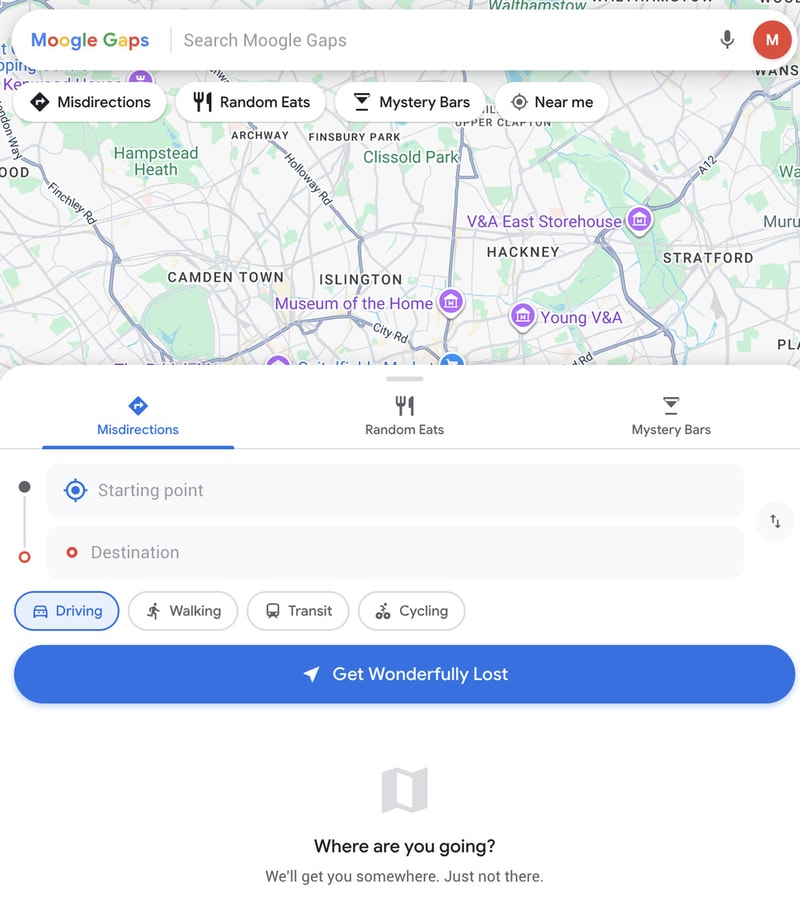
Some people prefer to map the most efficient route from Point A to Point B, but for those who love the journey as much as the destination, there's Moogle Gaps—a purposeful way to get lost, and potentially discover something new along the way.
Styled like a popular web-based mapping service, Moogle Gaps operates similarly by having users plug in their desired destination, but differs by prompting people to push "Get Wonderfully Lost" to receive intentional misdirections. And while many web maps make it easy to find nearby places to eat or drink, Moogle Gaps suggests random eats and mystery bars, challenging users to give up the usual research spiral in favor of a surprise that might just turn out to be exactly what was needed.
What Makes This Trend Stand Out
- Serendipity Navigation
- Platforms that prioritize unexpected detours over optimal routes create opportunities for novel discovery-driven experiences that reframe utility around surprise and delight.
- Gamified Wayfinding
- By introducing playful prompts and randomized challenges into routing, navigation can be transformed into an engaging game layer that increases user retention and social sharing.
- Anti-optimization Travel
- A cultural shift away from efficiency toward mindful wandering supports services that monetize slow, exploratory journeys and curated randomness rather than fastest-path algorithms.
Sectors Adopting This
- Digital Mapping Services
- Mapping providers can be disrupted by alternative UX models that surface surprises and experiential recommendations instead of strictly optimized navigation data.
- Hospitality and F&B
- Independent restaurants and bars stand to benefit from referral systems that feed off randomized discovery flows, altering how foot traffic is generated beyond search-driven demand.
- Local Tourism and Discovery
- Community tourism operators may see new revenue models emerge from curated misdirection experiences that package hidden gems and nontraditional itineraries for visitors.