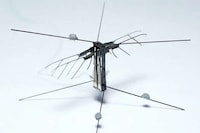
The milliDelta bot is the latest innovation in the realm of tiny robots and is gearing up to join the world of microsurgery. Developed by Harvard's Wyss Institute for Biologically Inspired Engineering and the John A. Paulson School of Engineering and Applied Sciences, this tiny robot is small enough to fit in a coin purse and can do more at incredible and precise speeds. Inspired by pop-up books and origami, the milliDelta bot folds to be even more compact with its sports-flexible joints and piezoelectric actuators that allow it to work with both force, precision and incredible speed.
While the robot has not yet been used in surgical procedures, the creators claim its ability in such realms. The milliDelta bot was developed using a technique called microelectromechanical systems (MEMS, which allows for complex structure from flat materials). The milliDelta bot is still a work in progress, as creators are still looking to refine its specs and add additional power and control electronics.
What Makes This Trend Stand Out
- Tiny Robots for Microsurgery
- The development of robots, like the milliDelta bot, continue to advance the possibilities of microsurgery.
- MEMS Technology Advancements
- The use of microelectromechanical systems technology for the creation of robots like the milliDelta bot has opened the doors for new possibilities.
- Foldable Robotics
- Inspiration from origami and pop-up books may lead to the development of even more compact and highly versatile robots in the future.
Sectors Adopting This
- Medical Devices Industry
- Medical device companies can invest in research and development to leverage miniature robots, like the milliDelta bot, for minimally invasive surgeries.
- Robotics Industry
- Robotics companies can take inspiration from the milliDelta bot and continue to innovate and advance with the use of MEMS technology in smaller and more precise robots.
- Educational Publishing Industry
- The development of robots, like the milliDelta bot, that incorporate principles of origami and pop-up books may provide opportunities for educational publishing companies to create interactive and engaging learning tools for students.