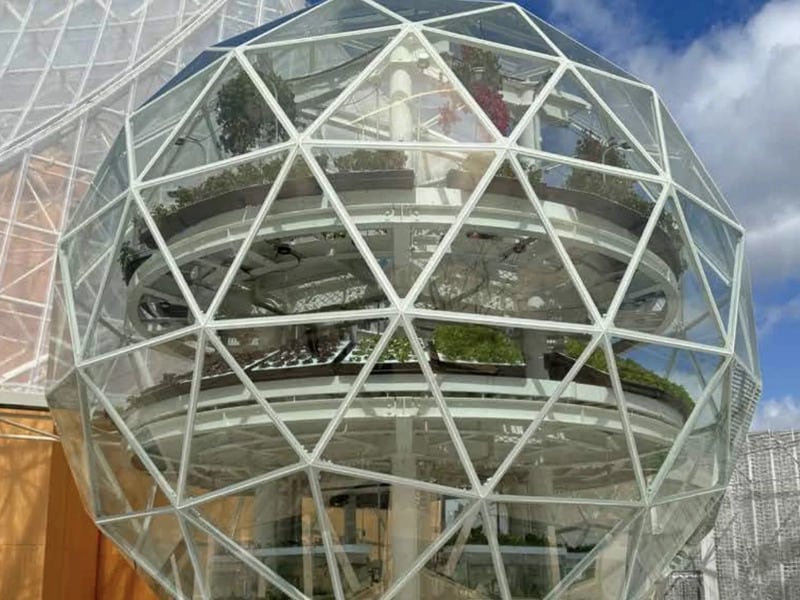
Living Sphere introduces a vertically layered food ecosystem inside a transparent geodesic dome designed for compact urban environments. The structure integrates aquaculture tanks below with hydroponic growing beds above to support both fish and plant cultivation within a single closed system. Different water zones allow salt-tolerant and freshwater crops to grow simultaneously using nutrients produced by fish waste. Sunlight passes through the dome structure to maintain internal climate balance while supporting year-round food production.
Water continuously circulates through biological filtration, where beneficial microbes convert waste into usable nutrients for plants before being returned to the tanks. This closed-loop design reduces the need for external fertilizer or large water exchanges. The system is intended for rooftops, narrow city sites, and regions with limited arable land.
Image Credit: Viking Dome
What's Driving This Trend
- Vertical Farming Innovation
- Combining vertical farming with integrated aquaculture, a new paradigm emerges for sustainable urban agriculture.
- Aquaponics Expansion
- The incorporation of salt-tolerant and freshwater crops in aquaponic systems enables diverse food production in limited spaces.
- Urban Climate Adaptation
- Transparent geodesic domes facilitate year-round food production by leveraging natural sunlight for climate control.
Who This Affects Most
- Sustainable Agriculture
- Innovative systems like Living Sphere rejuvenate sustainable agriculture by eliminating dependency on external fertilizers and extensive water use.
- Urban Development
- The self-contained food production systems cater to urban development needs, effectively utilizing rooftops and narrow spaces in city environments.
- Renewable Energy
- Maximizing the use of passive solar energy within geodesic domes creates intersections with renewable energy advancements.