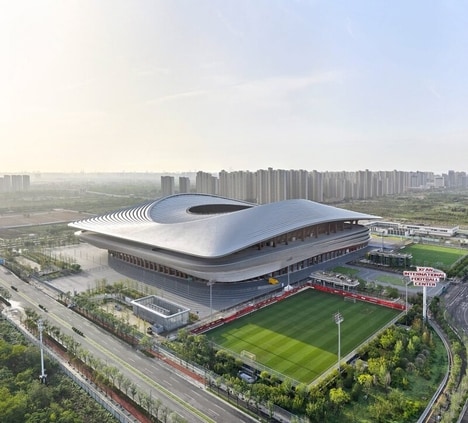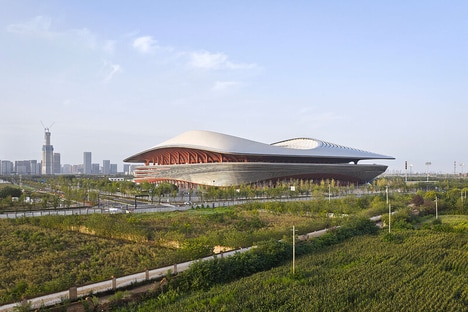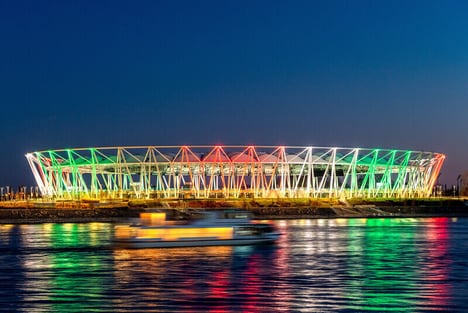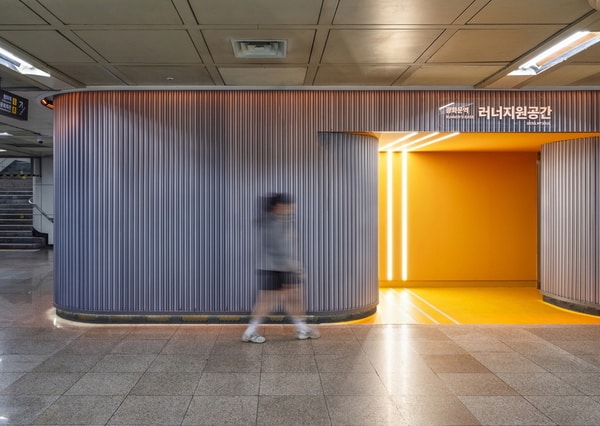
UNS has completed the Korean Football Park, a sprawling 450,427-square-metre campus in Cheonan, South Korea, that redefines the concept of a national training ground by transforming it into a multi-functional civic destination for both elite athletes and the public.
Conceived at the onset of the COVID-19 pandemic as a beacon of hope for the sport, the project moves far beyond a simple collection of pitches. UNS integrates the Korean Football Association's headquarters directly with an outdoor stadium to foster unprecedented proximity between decision-makers, coaches, and players. This master plan, designed as a terraced landscape responding to the site's mountainous topography, organizes a rich program that includes 11 football fields, an indoor climate-controlled arena, a soon-to-be-built museum, a high-end hotel and spa, and dedicated facilities for youth and women's development.
Image Credit: Rohspace
What Makes This Trend Stand Out
- Civic Training Campuses
- Elite sports facilities are evolving into public-facing destinations where recreation, culture, hospitality, and athlete development coexist in one accessible environment.
- Integrated Sports Governance
- Placing federation headquarters alongside training and competition spaces creates new models for faster collaboration between administrators, coaches, and athletes.
- Terrain-adaptive Architecture
- Large-scale athletic campuses built into natural landscapes demonstrate how topography can shape immersive, sustainable, and multifunctional venue experiences.
Sectors Adopting This
- Sports Architecture
- Design firms can differentiate through campus concepts that combine performance infrastructure with civic amenities and year-round public engagement.
- Athlete Development
- Training organizations are gaining new pathways to support youth, women, and elite players through specialized facilities embedded within national sports ecosystems.
- Sports Tourism
- Hotels, museums, spas, and stadiums within training grounds expand the commercial potential of sports destinations beyond match-day attendance.