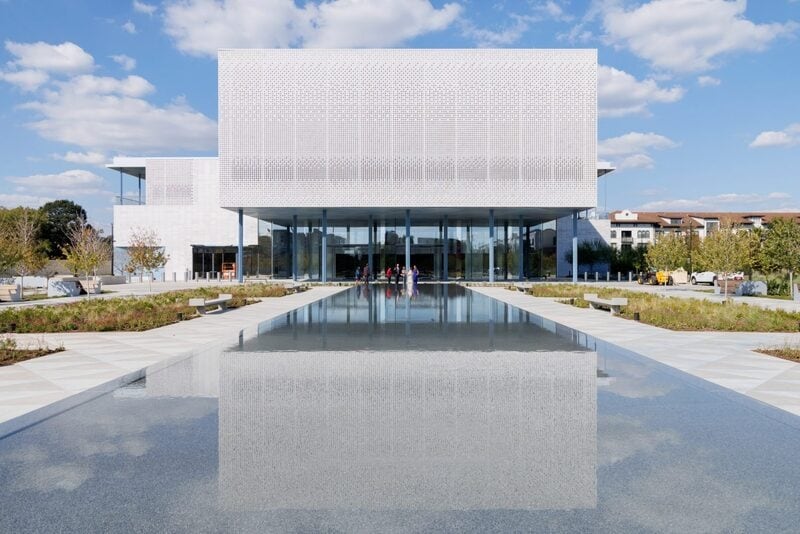
The Ismaili Center Houston by Farshid Moussavi merges faith, art, and architecture in a 150,000-square-foot complex that serves as a cultural and spiritual hub. Located on an 11-acre site, the center features limestone façades, a glass-lined atrium, and landscaped courtyards designed to promote openness and community engagement. Its geometric arches and star-shaped columns reinterpret Islamic architectural language through contemporary form and material precision.
Landscaped by Nelson Byrd Woltz, the surrounding gardens connect the building to Houston’s ecology while offering spaces for reflection and gathering. Interior programs include a prayer hall, theatre, exhibition areas, and public amenities, all arranged around the central atrium to encourage natural light and circulation. The project establishes a new civic landmark for the Ismaili community, positioning architecture as a dialogue between cultural heritage, inclusivity, and modern urban design.
Image Credit: Iwan Baan
What's Driving This Trend
- Modern Architectural Synthesis
- Merging traditional design elements with contemporary materials, architectural projects that fuse past and present aesthetics are gaining traction in urban landscapes.
- Ecological Integration
- Designing buildings that harmonize with their natural surroundings, such as incorporating local ecology into landscape architecture, is becoming a key focus for sustainable urban development.
- Civic Engagement Spaces
- Facilities designed to facilitate community interaction through open and versatile spaces reflect a shift towards urban centers that prioritize civic and cultural connectivity.
Who This Affects Most
- Architecture and Design
- As demand grows for innovative structures that respect cultural heritage while embracing modernism, architecture firms are pushing the boundaries of design to create new cultural landmarks.
- Sustainable Urban Development
- The emphasis on integrating natural landscapes into urban planning highlights a transformative approach within the sustainable development industry, aiming to create greener and more livable cities.
- Cultural and Community Spaces
- The creation of multifunctional centers that serve as cultural, spiritual, and communal hubs represents a significant evolution in how community spaces are conceptualized and utilized.