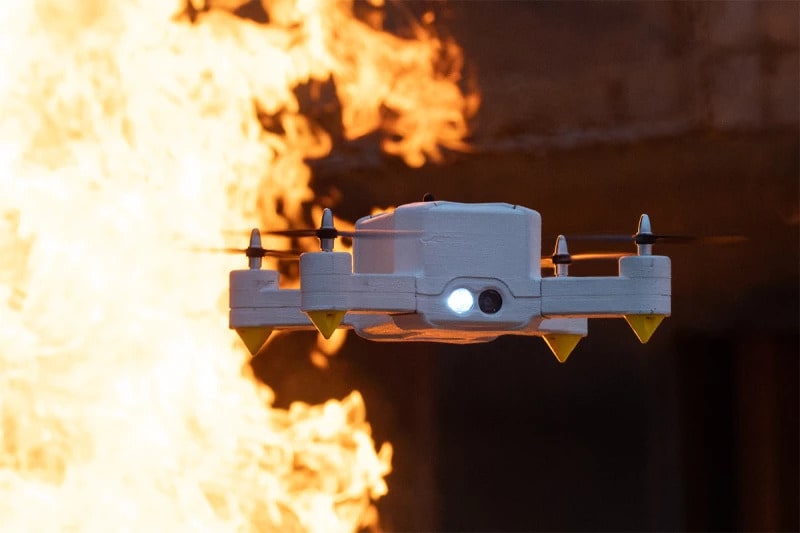
EMPA’s FireDrone is a specialized firefighting quadcopter designed to operate in extreme temperatures where conventional drones fail. Developed by the Swiss Federal Laboratories for Materials Science and Technology, the unmanned aircraft features a polyimide aerogel shell that insulates its electronics, allowing it to survive brief exposures to intense heat. This protective structure evolved from earlier composite designs tested in 2023, when prototypes withstood temperatures far beyond typical consumer drones.
The current FireDrone integrates an internal temperature management system that monitors core components and activates active cooling to extend operational time in 392 °F environments. It carries visual and thermal cameras to transmit real-time imagery to a large remote display for multi-person review. Optimized for indoor navigation, it uses pilot assistance and localization tools that function even without GPS, enabling controlled flights through tunnels, industrial facilities, and multi-story buildings.
For firefighters and industrial operators, FireDrone offers a way to gather critical situational data before sending people into dangerous zones. Its ability to scout smoke-filled structures, monitor long-cooling industrial fires, and potentially carry gas-detection sensors helps reduce exposure to toxic fumes and unexpected explosions. As the EMPA spinoff moves from research to commercialization, the system’s planned docking station and reporting software underscore a broader trend toward robotics-enabled emergency response that prioritizes safety and precision.
Image Credit: EMPA
What's Driving This Trend
- Robotics-enabled Emergency Response
- The development of drones like FireDrone highlights a shift toward using advanced robotics for safer and more precise emergency interventions.
- Heat-resistant Technology
- FireDrone's polyimide aerogel shell exemplifies advancements in materials science, paving the way for electronic devices capable of functioning in extreme temperatures.
- Intelligent Drone Navigation
- The integration of pilot assistance and GPS-independent localization underscores the evolution of drones towards intelligent navigation systems suited for complex indoor environments.
Who This Affects Most
- Firefighting Equipment
- The introduction of drones with thermal-tolerance capabilities offers a breakthrough in firefighting technologies by enabling safer data collection in hazardous environments.
- Materials Science
- Innovations in aerogel insulation as demonstrated by EMPA's FireDrone suggest transformative opportunities in developing ultra-light, heat-resistant materials for various applications.
- Industrial Safety
- The use of drones for monitoring industrial fires and hazardous environments signals a growing industry focus on leveraging technology to enhance worker safety and operational efficiency.