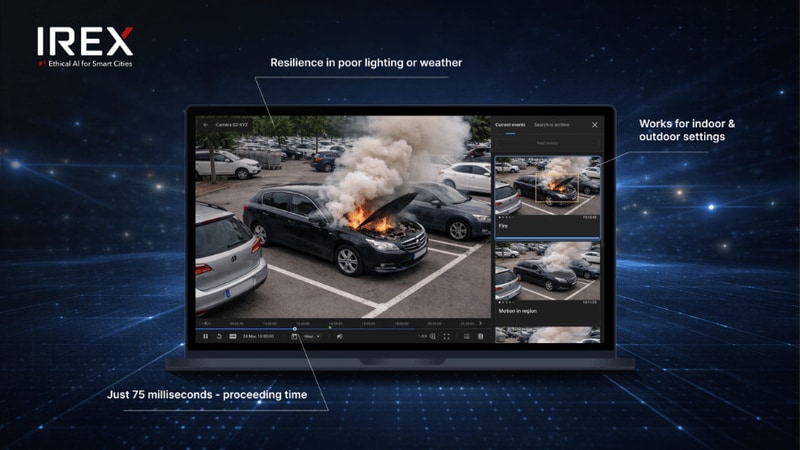
IREX updated its FireTrack smoke and fire detection module to analyze existing CCTV feeds in real time, featuring segmentation masks that mark fire and smoke areas and process frames in about 75–105 milliseconds. The upgrade was introduced by IREX in April 2026 and runs on current camera networks without requiring extra sensors.
The model tracks how fire and smoke evolve over time to distinguish true hazards from benign visuals like fog or glare. The release emphasized improved resilience in low light and adverse weather and delivers a snapshot with each detection for quick operator verification. By using segmentation instead of bounding boxes, FireTrack better localizes irregular flames and plumes, reducing false alarms.
This enables faster, more focused responses from safety teams and offers organizations a cost-effective route to scale fire protection across infrastructure and natural areas.
Image Credit: IREX
What Makes This Trend Stand Out
- Edge Video Fire Detection
- Low-latency processing of CCTV frames at the edge enables near-instantaneous detection and localization of flames and smoke, offering a path to scalable, real-time hazard monitoring without cloud dependence.
- Temporal Evolution Modeling
- Models that analyze fire and smoke progression over consecutive frames significantly improve differentiation between true hazards and transient visuals such as glare or fog, creating opportunities for smarter alarm validation.
- Segmentation-based Localization
- Pixel-level segmentation of fire and smoke regions provides more precise spatial understanding of irregular plumes than bounding boxes, opening the possibility for targeted responses and reduced false positives.
Sectors Adopting This
- Wildfire Management
- Early, accurate detection from existing camera networks can transform large-area monitoring by enabling quicker situational awareness of nascent hotspots across remote landscapes.
- Industrial Facilities
- Enhanced resilience in low light and adverse conditions supports continuous hazard surveillance in complex plant environments where conventional sensors may be impractical or costly.
- Property and Casualty Insurance
- Real-time, verifiable snapshots tied to detections can recalibrate risk assessment and claims workflows by providing finer-grained evidence of fire events and false alarm rates.