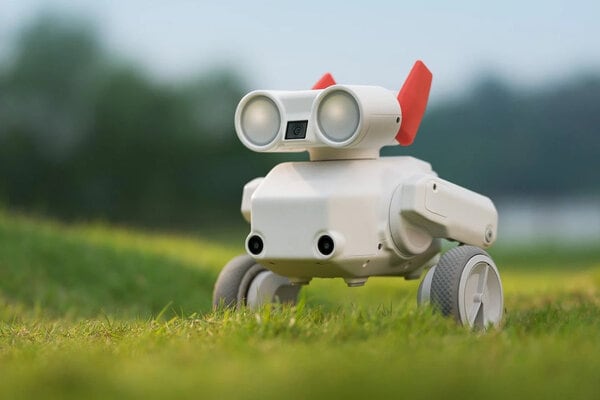

Faraday Future launched its robotics camps in partnership with the Lynwood Unified and El Segundo Unified school districts and education institution Triple I, bringing hands-on embodied AI training to students across Los Angeles. Rather than using toy kits, participants train on Faraday Future's robotics fleet, including the quadruped platforms 'Navi' and 'Aegis' and the bipedal humanoid 'Master,' progressing from basic coding to a live autonomous systems showcase by the end of the program.
The five-day curriculum guides students through sense-think-act logic, AI vision missions, mechanical engineering fundamentals and humanoid kinematics, with a daily timed racetrack challenge culminating in a data analytics lesson based on each student's performance.
Faraday Future shows how robotics companies can use hands-on educational programs to introduce embodied AI while helping develop future engineering talent.
Image Credit: Faraday Future
Key Themes Behind This Trend
- Embodied-AI Learning
- Hands-on access to real robotics fleets introduces students to autonomous systems while creating early familiarity with next-generation AI hardware.
- Industry-led STEM Camps
- Corporate partnerships with school districts expand technical education beyond classrooms and position companies as talent-development ecosystems.
- Performance-based Robotics Training
- Timed challenges and analytics-driven lessons turn student activity data into a practical pathway for personalized engineering education.
Where This Applies
- Education Technology
- Robotics-centered curricula can transform STEM learning through immersive platforms that blend coding, mechanics and AI vision.
- Robotics
- Youth training programs using commercial-grade machines create new channels for market exposure, workforce development and product feedback.
- Automotive Technology
- Mobility companies with autonomous systems expertise can extend their platforms into education, talent pipelines and embodied-AI services.