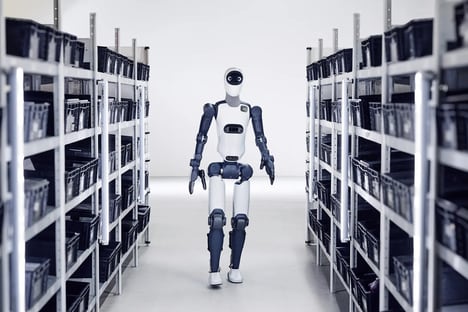
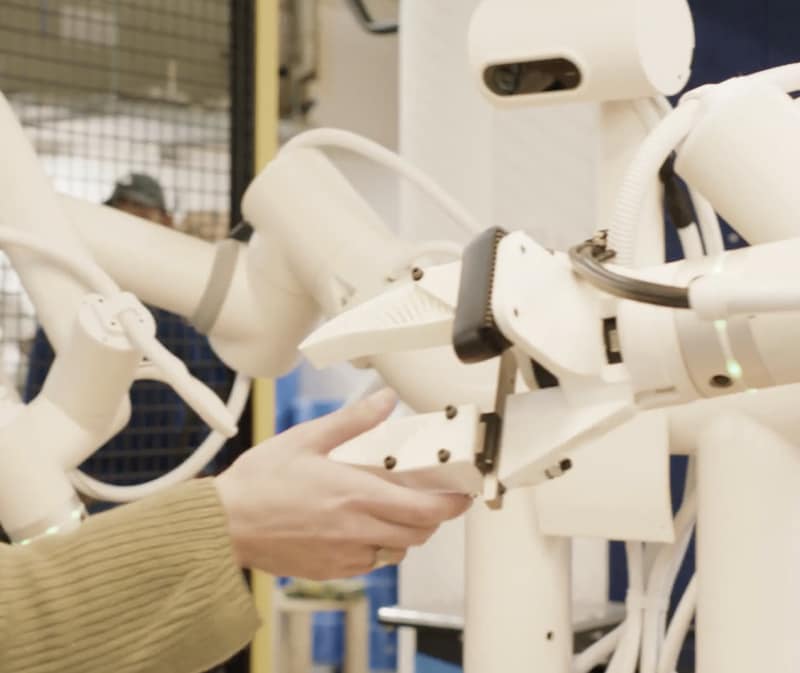
Tutor Intelligence unveiled Data Factory 1 (DF1), a new headquarters in Watertown, Massachusetts housing a 100-robot fleet designed to learn how to manipulate everyday objects through vision-language-action models and human-in-the-loop supervision. The robots, nicknamed Sonny, are mounted at fixed stations and equipped with four cameras each as the startup begins large-scale data collection inside the renovated facility.
DF1 combines onsite engineers with remote supervisors across the U.S., Mexico and the Philippines who monitor and correct robot behaviour at scale. The system is powered by Tutor’s Ti0 vision-language-action model, which the company is using to train robots for general-purpose manipulation and dexterity tasks.
For manufacturers and logistics operators, DF1 represents a push toward more adaptable robotic systems capable of improving pick-and-place performance while reducing reliance on expensive sensor hardware through a camera-first approach. The initiative also reflects a broader effort to bridge the gap between robotics research and commercial deployment by generating the large labelled datasets needed for scalable automation.
Image Credit: Tutor Intelligence
What Makes This Trend Stand Out
- Camera-first Robotics
- Camera-first designs that rely on multi-view vision instead of expensive bespoke sensors create potential for lower-cost, widely deployable manipulation systems.
- Human-in-the-loop Remote Supervision
- By integrating distributed remote supervisors with onsite engineers, scalable correction workflows emerge that can accelerate model improvement and reduce field downtime.
- Data-centric Robot Learning
- The buildup of large, labeled manipulation datasets foregrounds opportunities for general-purpose models that transfer dexterity across tasks and hardware.
Sectors Adopting This
- Manufacturing and Logistics
- Flexible, camera-led robotic fleets stand to disrupt traditional pick-and-place lines by enabling adaptable automation that tolerates product and layout variation.
- Robotics Platform Providers
- Standardized multi-robot facilities and shared models could create new platform business models centered on fleet-based learning and continuous capability upgrades.
- Data Labeling and Annotation Services
- The demand for high-quality, task-specific annotations at scale points to emerging markets for specialized labeling pipelines and tooling tuned to robot perception needs.