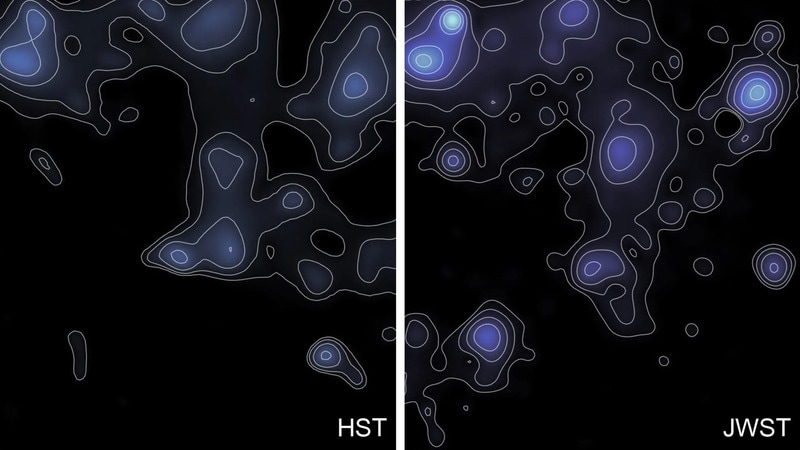
Researchers led by Durham University, NASA JPL and EPFL produced a new dark matter map using observations from NASA’s James Webb Space Telescope, featuring unprecedented resolution in a sky region in Sextans. The team used Webb’s deep imaging and MIRI mid-infrared data to detect nearly 800,000 galaxies across a field observed for roughly 255 hours, with dark matter inferred via gravitational lensing effects.
The map covers about 2.5 times the full Moon and contains about ten times more galaxies than earlier ground-based surveys and twice as many as Hubble maps of the same patch. Webb’s clarity revealed finer concentrations of unseen mass and improved alignment measurements between dark and ordinary matter, while MIRI helped penetrate dust-shrouded systems.
For consumers of science—researchers and the public alike—this sharper dark map refines how cosmic structure formed and where galaxies emerged, informing future surveys with ESA’s Euclid and NASA’s Roman. It establishes a high-resolution reference that will guide comparisons and deeper studies of dark matter’s role in cosmic evolution.
Image Credit: Dr. Gavin Leroy/Professor Richard Massey/COSMOS-Webb collaboration
Key Themes Behind This Trend
- High-resolution Dark Matter Mapping
- Advancements in telescope technology like the James Webb enable unprecedented high-resolution mapping of dark matter, significantly enhancing our understanding of cosmic structures.
- Galactic Gravitational Lensing
- Gravitational lensing observations facilitated by powerful space telescopes allow for more precise detection and mapping of galaxies, paving the way for breakthroughs in dark matter research.
- Mid-infrared Astronomical Imaging
- Utilizing mid-infrared data from instruments like MIRI helps penetrate dust and reveal clearer images of galaxies, offering fresh insights into the universe's hidden components.
Where This Applies
- Space Exploration Technology
- Technological advances in space telescopes support the exploration and detailed mapping of celestial phenomena, leading to revolutionary discoveries in the understanding of space.
- Astronomical Data Analytics
- The wealth of data from high-resolution cosmic surveys drives the need for robust data analytics tools to process and understand complex astronomical information.
- Public Science Communication
- Sharper visualization of dark matter phenomena can enhance educational outreach and public science engagement by making complex space research more accessible and understandable.