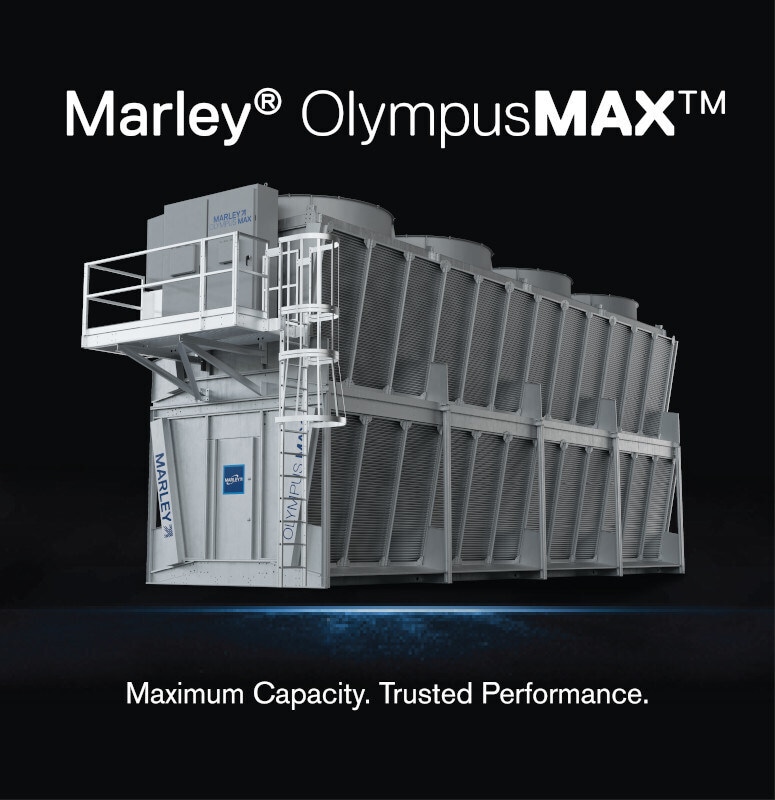
SPX Cooling Tech has introduced the Marley® OlympusMAX™ Fluid Cooler, a new system designed for dry and adiabatic cooling in mission-critical environments such as data centers, industrial plants, and other high-density cooling applications where managing heat generation is essential to operational stability.
The unit is available in both dry and adiabatic configurations, with a bolt-on adiabatic module that can be added at the factory, during field installation, or even after the equipment has already been running. This capability provides facility managers with the flexibility to adapt to changing thermal loads or water availability over time.
SPX Cooling Tech's patent-pending recirculating adiabatic design reduces blowdown, meaning the system discharges less water compared to traditional once-through or spray-based approaches, while also delivering more uniform water flow across the saturation pad to extend pad life and reduce mineral buildup on sensitive components.
Image Credit: SPX Cooling Tech
Why This Trend Is Growing
- Modular Hybrid Cooling Systems
- Combines dry and adiabatic modes with bolt-on modules to allow incremental adaptation of cooling capacity and water use over equipment lifecycles.
- Low-water Recirculating Adiabatic Design
- Characterized by reduced blowdown and recirculating water flow that lowers overall water consumption while minimizing mineral buildup on heat-exchange components.
- Field-upgradeable Thermal Infrastructure
- Enables retrofit or post-deployment upgrades that align thermal performance with evolving compute density and site water-availability constraints.
Industries Being Reshaped
- Data Center Operations
- High-density compute environments where adaptive, low-water cooling architectures directly affect uptime, energy efficiency, and server longevity.
- Industrial Manufacturing
- Process plants facing variable heat loads and mineral-laden water sources that benefit from uniform saturation flow and reduced maintenance intervals.
- Critical Facilities Management
- Mission-critical sites that require flexible cooling strategies to maintain operational stability amid changing demand and constrained utilities.