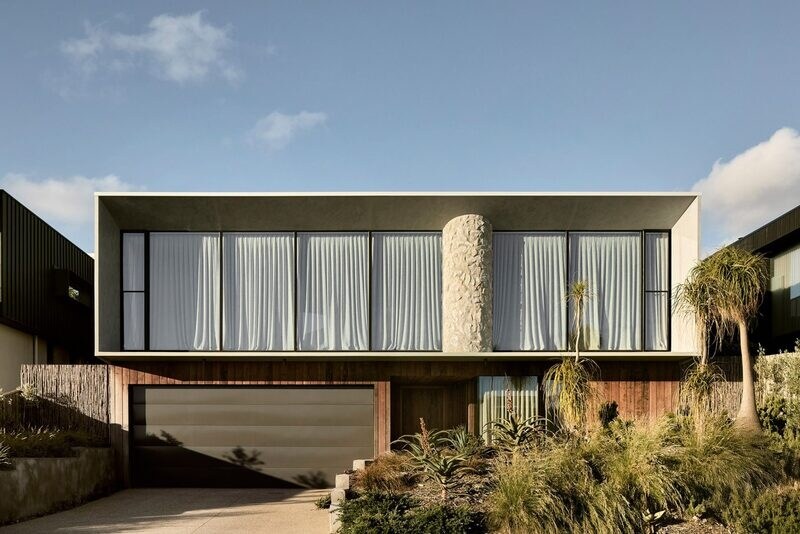
The Coastal House is a residential project by Splinter Society that sits on an elevated seaside site in Ocean Grove, Victoria, Australia, designed for a large family with a focus on indoor-outdoor living and environmental responsiveness. The layout wraps living spaces around a central courtyard and pool to create sheltered outdoor areas while maintaining views toward the coast.
The building’s form uses overlapping volumes and a layered arrangement of materials chosen to withstand coastal exposure, including timber cladding on lower levels and a cantilevered concrete volume above that frames expansive outlooks. Natural light is brought deep into the interior through carefully placed openings and top lighting.
The residence organizes private and communal spaces to balance social interaction with moments of retreat. Guest bedrooms, support spaces, and storage are located on the lower level, while primary living spaces and main bedrooms occupy the upper floor with direct access to outdoor decks. Material choices such as textured limestone elements and a warm, natural palette reinforce a connection to place, while open plan living and the semi-courtyard layout support casual family use and year-round coastal breezes.
Image Credit: Splinter Society
Key Themes Behind This Trend
- Climate-responsive Coastal Design
- Homes optimized for sea breezes and elevated siting enable new design strategies that integrate passive ventilation and flood-resilient massing.
- Layered Durable Materials
- A combination of timber, concrete, and textured stone suggests novel composite systems and protective finishes tailored for saline environments.
- Semi-courtyard Indoor-outdoor Living
- Central courtyards and sheltered outdoor rooms point to rethinking spatial programming for year-round coastal lifestyles.
Where This Applies
- Residential Architecture
- Architectural firms can develop repeatable design typologies that balance communal and private zones for extended-family coastal living.
- Building Materials & Coatings
- Product manufacturers may formulate long-lasting, low-maintenance cladding assemblies and corrosion-resistant coatings specific to marine exposure.
- Modular and Prefabricated Construction
- Factory-built overlapping volumes and cantilevered modules indicate potential for precision-engineered, transportable coastal components.