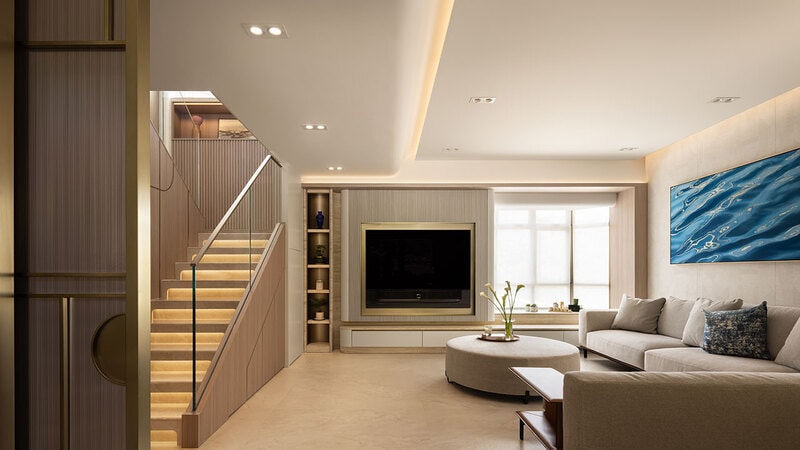
The Clement C Studio project reworks a duplex residence in Hong Kong into a home shaped by sensory experience rather than rigid spatial division. Located above Repulse Bay, the interior is organised through softened geometry, curved surfaces, and continuous transitions that guide movement across both levels. Rounded corners and flowing thresholds reduce visual interruption and encourage a slower, more tactile engagement with space.
Material choices emphasise texture and touch, with finishes selected to respond to changing light throughout the day. Textured wall surfaces, wood-grain treatments, and full-body stone elements introduce variation while maintaining visual cohesion. Built-in furniture and integrated storage reinforce spatial continuity and reduce clutter within the compact footprint. Colour is used selectively to distinguish zones without enclosing them, allowing spaces to remain open and adaptable.
Image Credit: Clement C Studio
What's Driving This Trend
- Sensory-driven Interiors
- Residences oriented around multisensory cues prioritize touch, light and acoustics over conventional layouts, enabling new forms of experiential living environments.
- Continuous Spatial Flow
- Softened geometry and flowing thresholds promote uninterrupted movement and perceptual cohesion across levels, redefining how spatial programs are organized in compact sites.
- Tactile Materiality
- A focus on texture, wood-grain treatments and full-body stone introduces layered sensory variation that challenges standard finish hierarchies and product specifications.
Who This Affects Most
- Residential Architecture
- Design practices that emphasize sensory sequencing and integrated furnishings are positioned to disrupt typical zoned floorplans and spec-driven construction methods.
- Luxury Hospitality
- Boutique hotels and resorts highlighting immersive, tactile environments can redefine guest expectations for comfort and narrative-driven spatial experiences.
- Furniture and Surface Manufacturing
- Producers of built-in furniture and high-fidelity surface materials face opportunities to develop modular, texture-forward components tailored to continuous, curved interiors.