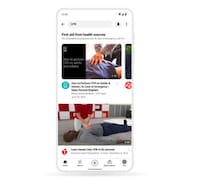
ChatCPR is an open-source AI agent for CPR coaching, grounded in 911 dispatcher training models and best practices, and in a recently published study, it outperformed human dispatchers in guiding bystanders through cardiopulmonary resuscitation. Published in JAMA Internal Medicine, the study revealed that ChatCPR excelled in patient assessment, chest compression depth and rate instructions—where dispatchers met 85% of basic CPR steps, ChatCPR met 100%, and for more advanced guidance, ChatCPR scored 99% while dispatchers scored 63%.
“If AI is going to earn its place in medicine, it should start by helping people save the person right in front of them,” said John W. Ayers, Ph.D., a UC San Diego Qualcomm Institute scientist, Head of AI at the UC San Diego Altman Clinical and Translational Research Institute, professor at the UC San Diego School of Medicine, and study co-author.
Image Credit: Qualcomm Institute UC San Diego
Key Themes Behind This Trend
- AI-guided Emergency Response
- AI-driven coaching systems demonstrate the potential to standardize and elevate the quality of bystander interventions during cardiac arrests, reducing reliance on variable human dispatcher performance.
- Open-source Clinical AI
- Community-developed, transparent AI models are emerging as credible clinical tools that can be audited, iterated, and deployed rapidly across diverse emergency settings.
- Performance-exceeding Human Dispatchers
- Automated agents are beginning to surpass trained dispatchers on adherence to clinical protocols and advanced guidance metrics, shifting expectations for remote clinical decision support.
Where This Applies
- Emergency Medical Services
- Prehospital care pathways stand to be transformed by integrated AI coaching that augments dispatcher capacity and standardizes life-critical instructions at scale.
- Telemedicine Platforms
- Virtual care providers could embed real-time AI coaching to extend acute response capabilities beyond traditional clinical environments and into consumer devices.
- Public Safety Communications
- 911 centers and public safety agencies may see their operational models disrupted as automated conversational agents shift call triage, guidance consistency, and resource allocation.