
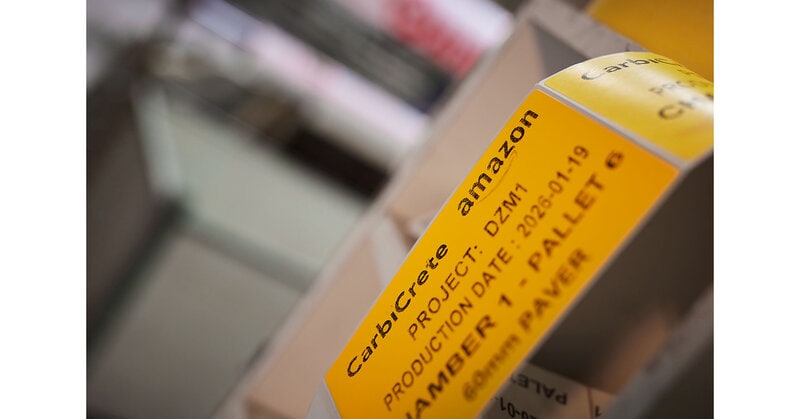
Cement-free concrete pavers are gaining commercial traction as CarbiCrete completes its first large-scale paving deployment at Amazon's new delivery station in Stockton-on-Tees, UK. Covering approximately 6,400 square metres of parking areas and walkways, the installation demonstrates how lower-carbon construction materials can be incorporated into major industrial facilities.
CarbiCrete's manufacturing process replaces conventional cement with a by-product from steel production, eliminating the need for cement in its paving products. Carbon dioxide is then used during curing, permanently trapping the gas within the finished concrete. Three different paving products were supplied for the Amazon project.
For CarbiCrete, this deployment provides a commercial example of its technology operating at scale. The project could support future construction opportunities as the company explores additional installations with Amazon and expands its manufacturing presence across Canada, Europe, the United States, and Australia.
Image Credit: CarbiCrete
What Makes This Trend Stand Out
- Cement-free Construction
- Low-carbon binders made from industrial by-products are creating new material pathways for commercial buildings, logistics hubs, and infrastructure projects seeking lower embodied emissions.
- Carbon-cured Materials
- CO2 mineralization in concrete products introduces a durable storage model that turns construction components into carbon-sequestering assets.
- Circular Industrial Inputs
- Steel production by-products are becoming valuable feedstocks for construction materials, linking heavy industry waste streams with scalable building-product innovation.
Sectors Adopting This
- Green Building Materials
- Demand for lower-emission concrete alternatives is reshaping supplier portfolios across pavers, blocks, precast elements, and other high-volume construction products.
- Logistics Real Estate
- Large delivery stations and warehouse campuses provide high-visibility testbeds for sustainable site materials across parking areas, walkways, and exterior infrastructure.
- Steel Manufacturing
- By-product valorization offers steel producers new relevance in circular construction supply chains as slag-based inputs replace carbon-intensive cement.