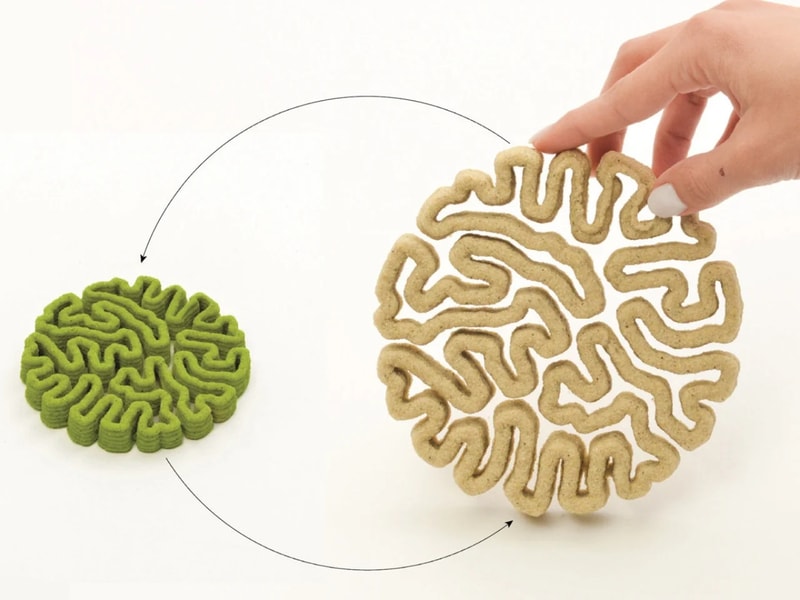
CyanoCement is a biocement developed by Perla Armaly, Yuval Berger, Lubov Iliassafov, Keren Rosenblau, Yechezkel Kashi and Shany Barath at the Technion – Israel Institute of Technology. Designed for 3D printing, the material incorporates cyanobacteria that use photosynthesis to produce calcium carbonate and form solid structures. CyanoCement is created through biological mineral formation. The material was developed for non-load-bearing architectural applications, including facades, interior panels and decorative building elements.
Living cyanobacteria remain active within the material after production, allowing it to continue absorbing carbon dioxide from the atmosphere. The organisms also give the material its natural green coloration, which serves as a visible indicator of biological activity. CyanoCement emerged from a collaboration between the Disrupt Design Lab at Technion's Faculty of Architecture and Town Planning and the Applied Genomics Lab within the Faculty of Biotechnology and Food Engineering.
Image Credit: Perla Armaly, Yuval Berger, Lubov Iliassafov, Keren Rosenblau, Yechezkel Kashi, Shany Barath
What Makes This Trend Stand Out
- Living Building Materials
- Biologically active construction substrates represent a shift toward surfaces that remain functional after installation, creating potential for buildings that sequester carbon and visually signal environmental performance.
- Carbon-capturing Facades
- Architectural envelopes with embedded photosynthetic organisms introduce new possibilities for non-load-bearing panels that combine aesthetics, climate benefits and measurable atmospheric carbon absorption.
- Bio-printed Architecture
- 3D-printed mineral-forming materials point to a future of customizable interior and decorative elements produced through low-carbon biological fabrication rather than conventional cement processing.
Sectors Adopting This
- Construction Materials
- The emergence of cyanobacteria-based cement alternatives expands the market for sustainable, non-structural products that reduce embodied carbon while adding ongoing carbon-capture functionality.
- Architecture and Design
- Design practices gain access to expressive green materials whose coloration and biological activity create differentiated facades, panels and spatial features with environmental storytelling value.
- Biotechnology
- Applied genomics and microbial mineralization are converging with the built environment, opening commercial pathways for engineered organisms that produce durable materials and climate-positive building components.