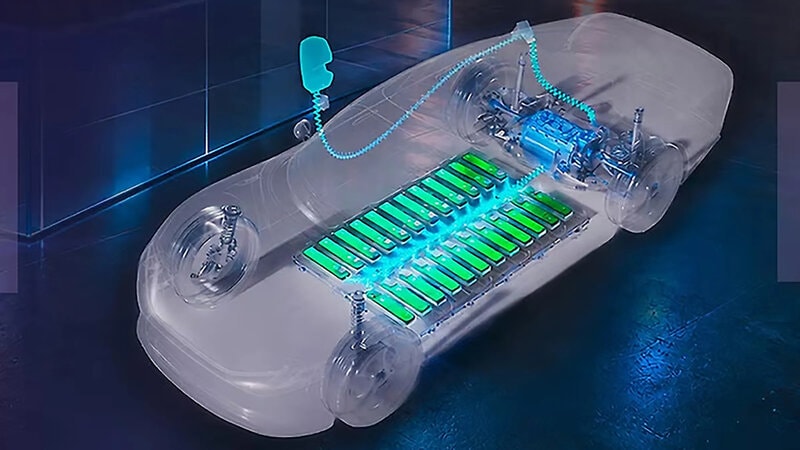
Mercedes-Benz’s ‘Power Converter’ brings cell-by-cell control to EV batteries, using software and microconverters to charge or discharge each cell independently instead of handling the pack as a single unit. That gives electric drive systems and charging hardware bidirectional voltage conversion across different battery layouts.
The system can maintain output at up to 800 volts even when cells have different charge levels or ages. It also separates high-voltage delivery from a fixed series cell count, so power moves only where it is needed. This supports smaller EV architectures and adds modularity during assembly. Treating cells individually can also extend battery pack life.
Cell-by-cell charging turns the battery pack into a more modular EV component, making smaller architectures more plausible without sacrificing output. An 800-volt target that no longer depends on a fixed series layout shifts battery design toward durability and assembly flexibility, not just raw cell count.
Image Credit: Mercedes-Benz
What's Driving This Trend
- Cell-level Battery Management
- Granular software control of individual battery cells creates openings for longer-lasting EV packs, adaptive charging profiles, and performance optimization beyond conventional pack-level systems.
- Modular EV Architectures
- Battery layouts that decouple voltage output from fixed cell counts could support smaller vehicle platforms, simplified assembly, and more flexible component reuse across model lines.
- Bidirectional Power Conversion
- Integrated microconverters within battery systems enable more precise energy routing, strengthening the potential for vehicle-to-grid services, resilient charging, and advanced onboard power distribution.
Who This Affects Most
- Electric Vehicles
- Automakers gain a pathway to lighter, more adaptable EV designs that maintain high-voltage performance while improving battery longevity and manufacturing flexibility.
- Battery Technology
- Suppliers focused on cells, modules, and power electronics may see new demand for intelligent components that balance aging, charge states, and voltage delivery at the cell level.
- Charging Infrastructure
- Charging networks and hardware providers could benefit from battery systems that manage voltage conversion internally, expanding compatibility across EV platforms and charge environments.