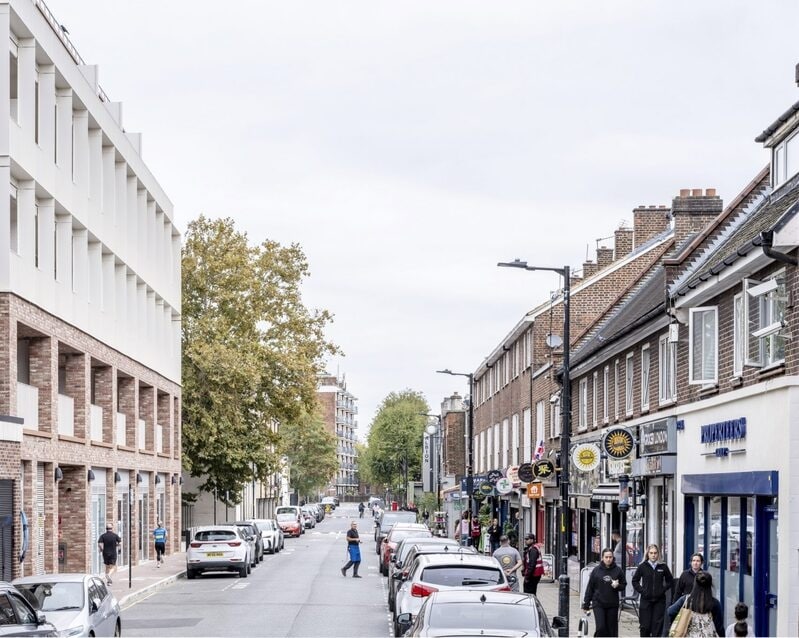
Albion Street housing delivers 26 new affordable residences in Rotherhithe as part of the London Borough of Southwark’s council home building programme. The project was designed by Bell Phillips Architects and completed in 2025. It comprises a mix of one-, two-, and three-bedroom apartments that exceed London Housing Design Guide standards, with dual-aspect layouts, private balconies, and access to a shared roof terrace.
The development includes a flexible ground-floor space and a new public square addressing Rotherhithe High Street. Bell Phillips Architects designed the scheme to respond to its surrounding context, including two nearby Grade II-listed Scandinavian churches. The building provides affordable homes for social rent and shared ownership. The project forms part of a wider infill strategy intended to increase housing provision while improving the public realm within an established residential neighbourhood.
Image Credit: Kilian O'Sullivan
What's Driving This Trend
- Urban Infill Density
- Increasing the use of small-site infill to deliver affordable units creates potential for scalable design templates that optimize land use without extensive rezoning.
- Mixed-tenure Integration
- Combining social rent and shared ownership within single schemes opens pathways for financial models that blend revenue streams and long-term community stability.
- Contextual Heritage-responsive Design
- Design approaches that respect nearby listed buildings while increasing density suggest opportunities for adaptive facade systems and material kits that balance conservation with modern performance.
Who This Affects Most
- Affordable Housing Developers
- Developers focused on council-led programmes may find disruptive cost-efficiency gains through standardized unit typologies and integrated public-realm delivery.
- Modular Construction Manufacturers
- Prefabricated, dual-aspect apartment modules tailored for narrow urban plots could enable faster delivery schedules and reduced on-site disruption in established neighborhoods.
- Urban Public Realm Planning
- Planners creating new squares and shared terraces adjacent to housing projects indicate demand for multifunctional landscape components that enhance social cohesion while servicing infrastructure needs.