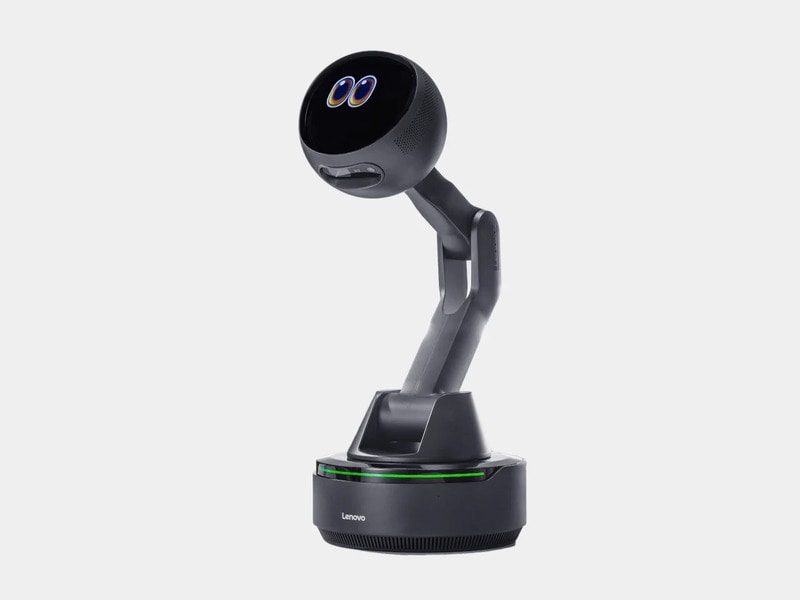
The bold Lenovo AI Workmate Concept is a desktop robot unveiled at MWC 2026 that combines an articulated mechanical arm with a spherical display showing animated eyes. The arm enables the device to physically pivot and orient toward the user or objects on a desk, while integrated cameras and sensors allow it to scan documents and recognise activity. On-device AI processing supports voice interaction, note summarisation and presentation assistance through built-in microphones and speakers.
The new concept also includes a projection function that casts visual content onto nearby surfaces, reducing reliance on a conventional monitor. A circular light indicator at the base shifts colour to reflect system status and activity. The unit is designed as a stationary desktop device with controlled movement across a defined base area rather than free navigation.
Image Credit: Lenovo
What's Driving This Trend
- Expressive Desktop Robotics
- The emergence of desk-bound robots with animated faces and articulated arms creates new pathways for personalization and emotional engagement in daily work environments.
- On-device AI Processing
- Local AI compute and sensor fusion on small form-factor devices reduces latency and privacy risks while enabling continual, context-aware assistance without cloud dependency.
- Projection-based Display Alternatives
- Compact devices that project visuals onto nearby surfaces challenge the primacy of traditional monitors by offering flexible, space-saving ways to present information.
Who This Affects Most
- Workplace Productivity Tools
- Tools that integrate physical presence and conversational AI could transform how teams interact with digital workflows and asynchronous collaboration.
- Office Hardware Manufacturers
- Suppliers of desk peripherals and furniture face opportunities to embed motion, sensing, and projection into ergonomic products to redefine the modern workspace.
- Document Management and Scanning
- Automated desktop scanning with onboard recognition and summarization capabilities promises to streamline capture-to-insight pipelines for knowledge workers.