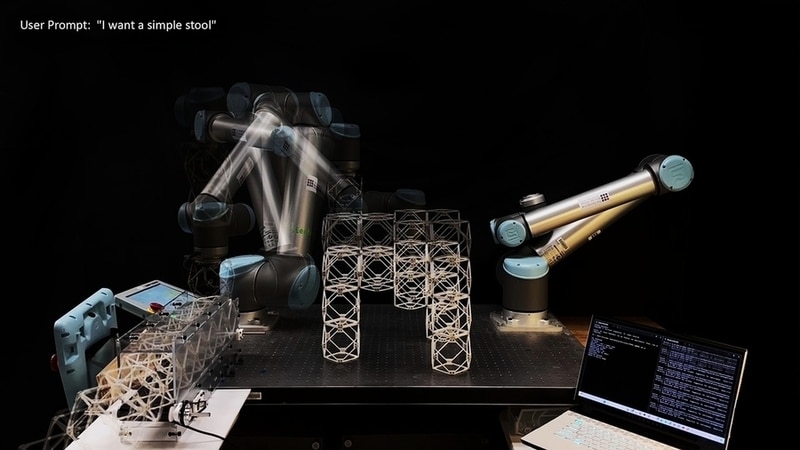
MIT researchers developed a “speech-to-reality” system that allows people to verbally describe an object and have a robot build it within minutes. The project combined generative AI with robotic assembly to translate natural language into physical items, such as stools, shelves, chairs, and decorative pieces. Its key differentiator is a seamless pipeline from spoken prompt to engineered, build-ready design.
The system integrated speech recognition, a large language model, 3D generative AI, geometric analysis, and a robotic arm that assembles modular, lightweight cubes. Behind the scenes, the software converted AI-generated 3D meshes into fabrication-aware structures, automatically accounting for overhangs, part counts, and connection points. This ensured the resulting objects could be assembled without collisions, remain stable under gravity, and be disassembled for reuse.
For consumers and creators, this approach hinted at a future where design and making are accessible without 3D modeling or coding skills. It dramatically reduced fabrication time compared to standard 3D printing and limited material waste by reusing modular components. As the team explores higher load capacities, mobile robots, and gesture-based control, the system showcased how AI-assisted making could reshape personalization, rapid prototyping, and on-demand home or workspace customization.
Image Credit: MIT Morningside Academy for Design
What Makes This Trend Stand Out
- Voice-activated Manufacturing
- Leveraging voice commands for manufacturing enables a seamless transition from idea to physical creation, eliminating the need for technical expertise in design software.
- Generative AI in Fabrication
- Generative AI's role in converting verbal descriptions into physical objects highlights its potential to revolutionize rapid prototyping and customization processes.
- Modular Robotics
- The use of modular components in robotic assembly underscores a shift towards sustainable building practices by enabling easy disassembly and material reuse.
Sectors Adopting This
- Furniture Production
- In the furniture industry, the integration of voice-led design and assembly offers new pathways for personalized and on-demand product creation.
- Home and Office Customization
- The ability to rapidly fabricate bespoke home or office elements via verbal requests portends significant shifts toward hyper-personalized living and workspaces.
- Robotic Manufacturing
- The enhancement of robotic systems with AI and voice capabilities heralds advancements in automated production processes across diverse sectors.